
Do I Need a Permit to Build a Deck? 2026 Guide
Deck permit rules vary by jurisdiction. This 2026 guide explains how height, attachment, zoning, repairs and replacements, setbacks, waterfront or floodplain constraints, plans, fees, and inspections determine whether a deck project needs approval, with current official examples.
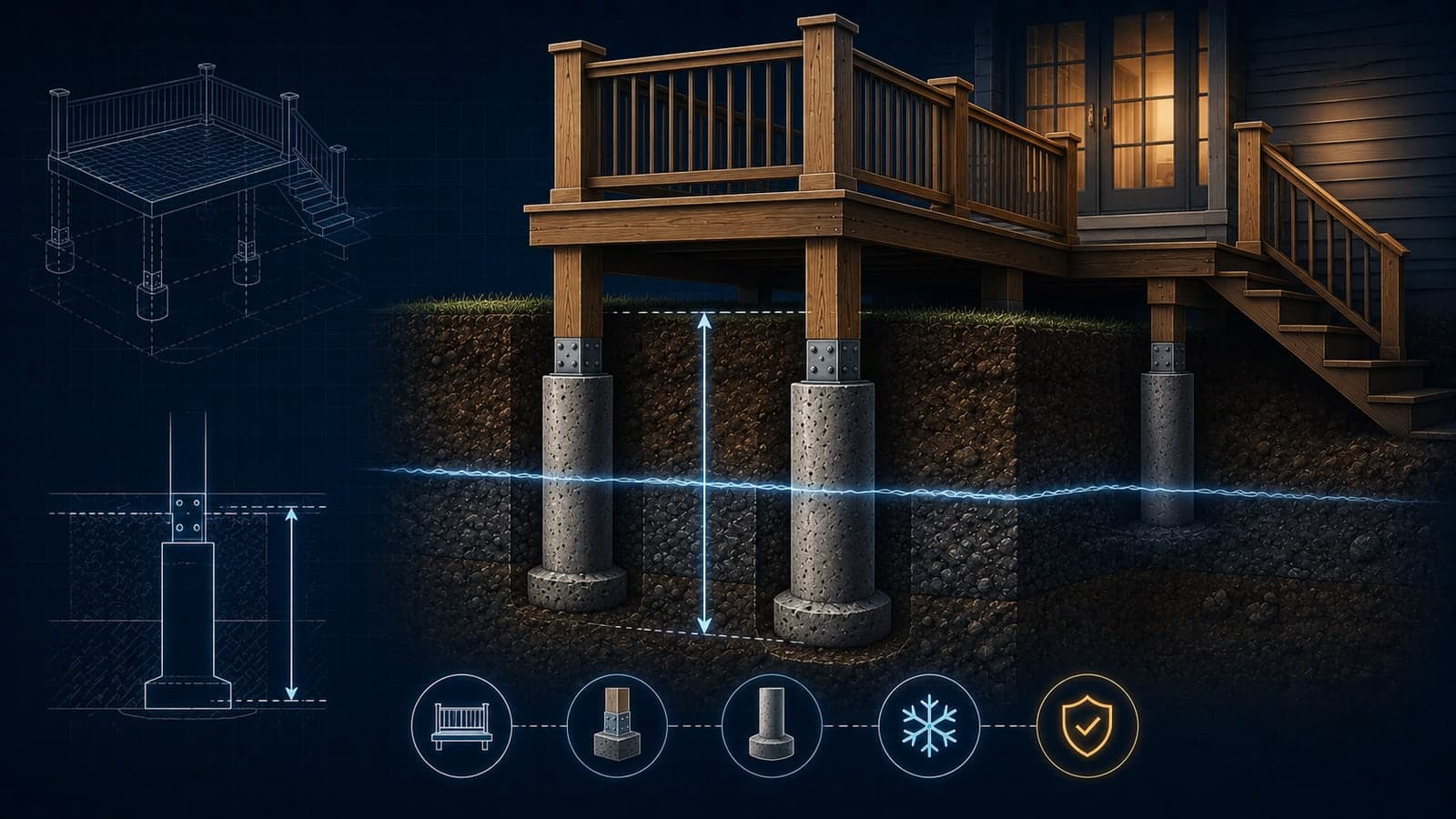
Direct answer: Whether you need a permit to build a deck depends on the rules adopted for your property, not on a single national height or size threshold. Seattle requires a permit for decks more than 18 inches above the ground, Portland uses a 30-inch building-permit threshold for uncovered residential decks, Madison says a permit is required to build a deck, and Minneapolis exempts only a narrow class of freestanding decks under 30 inches that are not attached to a structure with frost footings and do not serve the main entrance. The safest starting point is to check the deck's height, attachment, location, use, and local zoning before construction begins.
A deck permit also is rarely just a "deck question." The same project can trigger building review, zoning setbacks, lot-coverage limits, environmental or floodplain review, electrical permits, and inspections. This guide shows how to identify those layers before you spend money on final plans or start digging.
Key takeaways
- There is no universal U.S. deck-permit threshold. Local adoption and amendments control.
- Do not treat 30 inches as a national exemption. It is a common local threshold, but Seattle uses 18 inches and Madison requires a permit to build a deck.
- Attached vs. freestanding matters, but not the same way everywhere. Minneapolis specifically ties its exemption to a deck being freestanding and not attached to a structure with frost footings.
- A low deck can still have zoning requirements. Setbacks, lot coverage, overlays, easements, shoreland, floodplain, and historic rules can apply even when no building permit is required.
- Repairs and replacements are not automatically exempt. Madison, for example, allows some low-cost deck-board replacement without a permit but tells owners to check structural component replacement with Building Inspection.
- Permit plans usually need more than a sketch of the platform. A complete submittal commonly includes a site plan, deck dimensions, post and footing locations, beam and joist information, attachment details, stairs, and guards.
- Inspections must happen before required work is concealed. Footings are a common early inspection point.
- Permit cost and timeline are local facts. A credible national average is less useful than the current local fee schedule and review path.
- The fastest route to a useful answer is parcel-first. Start with the property, then the proposed deck dimensions and configuration.
Do I need a permit to build a deck?
You should assume a permit check is necessary for any new deck, deck replacement, structural deck repair, elevated platform, roof deck, or deck in a regulated area. Whether the final answer is "building permit required," "zoning review only," "exempt if conditions are met," or "multiple approvals required" depends on the authority having jurisdiction.
The most important variables are:
- Height above grade. Local rules may use the height of the walking surface above adjacent grade as a permit trigger.
- Attached or freestanding. A deck attached to the house creates a structural connection that may change the permit path.
- Use and egress. A platform serving a required entrance or exit can be treated differently from a detached backyard platform.
- Size and configuration. Large, multilevel, roofed, unusually framed, or solid-surface decks can enter a different review track.
- Location on the lot. Setbacks, easements, lot coverage, and environmental overlays can control where a deck may go.
- Added systems. Lighting, receptacles, hot tubs, gas appliances, outdoor kitchens, heaters, or roofs can add trade or structural permits.
- Existing conditions. Replacing an old deck, changing its footprint, or tying new work into a prior unpermitted structure can change the review.
The mistake to avoid is asking only, "Is my deck under 30 inches?" That can be one useful fact, but it is not a complete permit determination.
The 30-inch deck rule is not a national rule
You will see a version of the "30-inch rule" repeated across contractor sites, DIY forums, and permit articles. That shorthand is useful only after the local code confirms it.
Current official guidance shows why:
| Jurisdiction | Current official deck guidance | What it demonstrates |
|---|---|---|
| Seattle, Washington | A permit is required if a deck is more than 18 inches above the ground, is a roof deck, or is in an environmentally critical area. | A local permit trigger can be lower than 30 inches. |
| Portland, Oregon | An uncovered residential deck with a walking surface over 30 inches above the ground needs a building permit; lower decks still must satisfy zoning and may need zoning review in overlays. | A 30-inch threshold can coexist with separate zoning controls. |
| Minneapolis, Minnesota | A deck/platform may be permit-exempt only when it is freestanding, less than 30 inches high, not attached to a structure with frost footings, and does not serve the main entrance. | Height alone is not enough; attachment and use also matter. |
| Madison, Wisconsin | The city states that you need a permit to build a deck. | Some cities do not publish a broad low-deck exemption as the starting rule. |
| Milwaukee, Wisconsin | The city lists decks as requiring permits and requires plans for a new or replacement deck or porch before a building permit can be issued. | Replacement decks can be permit work, not just new decks. |
| Fairfax County, Virginia | Residential additions/alterations include decks, and county guidance lists decks among projects requiring permits. | Local permit systems may classify decks as additions/alterations rather than a special deck-only permit. |
The practical rule is simple: use national guidance to identify the questions, then use the responsible authority to answer them.
Official examples
- Seattle SDCI — Decks
- Portland Permitting & Development — Residential Decks
- Minneapolis — Work Exempt from Permit
- Minneapolis — Decks at Single-Family and Two-Family Dwellings
- Madison Development Services Center — Decks
- Milwaukee Department of Neighborhood Services — Decks and Porches
- Fairfax County — Does My Project Require a Permit?
Deck permit decision tree
Use this sequence before you design around an assumed exemption.
1. Is this new construction, structural replacement, or cosmetic maintenance?
A completely new deck should be checked for permits.
A complete tear-down and rebuild should also be treated as a new permit question, even if the replacement uses the same footprint.
A repair may be different. Replacing surface boards can sometimes be treated as maintenance, while changing joists, beams, posts, guards, stairs, footings, or the ledger can become structural work.
Madison gives a useful local example: it says deck boards may be replaced without a permit when the cost is under its published threshold, while replacement of stairs, joists, beams, columns, or guardrails should be permitted or discussed with Building Inspection. That is a Madison rule, not a national repair exemption.
2. How high is the walking surface above grade?
Measure the deck the way the local authority tells you to measure it. Sloped lots are where homeowners most often misclassify a "ground-level" deck.
One edge may sit only 12 inches above grade while the downhill corner is 32 inches above grade. That can put the project over a local threshold even though the deck appears low from the house.
Portland specifically instructs applicants to evaluate the walking surface relative to the ground and publishes its measurement method. Seattle uses a different height trigger altogether.
3. Is the deck attached to the house?
An attached deck usually relies on a ledger or another engineered connection to the building. That means the project must address:
- how loads transfer into the house,
- ledger fastening,
- flashing and water management,
- attachment to appropriate structural framing,
- lateral load resistance where required,
- conflicts with cantilevers, veneer, or other existing assemblies.
A freestanding deck carries its loads through its own posts, beams, and footings. That can simplify the connection to the house, but it does not automatically make the deck permit-exempt.
4. Does the deck serve an entrance or required exit?
A deck, platform, stoop, or landing that serves a dwelling entrance can be treated differently from a detached recreational platform.
Minneapolis explicitly makes this part of its exemption test: the permit-exempt deck/platform cannot serve the main entrance to the dwelling unit.
5. Will the deck have stairs or guards?
Stairs and guards bring additional safety requirements into the project. The rules can address:
- riser height,
- tread depth,
- stair width,
- handrails,
- guards,
- opening limitations,
- landings,
- illumination,
- attachment and loads.
Do not assume a low platform means the stair or guard work is exempt.
6. Will the deck be covered, screened, or support another structure?
A roof, screened enclosure, pergola, sunshade, or future porch can materially change the design loads and zoning analysis.
Portland specifically tells applicants that covered decks have additional zoning requirements. Seattle routes roof decks through a different permit path. Fairfax County has separately warned that adding a pergola to a deck can itself create permit questions.
If the long-term plan is "deck now, screened porch later," design and permit the foundation and structure with that future load in mind rather than assuming the original deck can support it.
7. Will the deck support a hot tub, outdoor kitchen, fireplace, or heavy equipment?
A hot tub can add thousands of pounds of concentrated load when filled and occupied. Outdoor kitchens, masonry fireplaces, large planters, and other heavy features can also exceed the assumptions of a basic prescriptive deck.
These features may trigger:
- structural engineering,
- dedicated footings,
- electrical permits,
- plumbing or gas permits,
- bonding and disconnect requirements,
- fire clearances,
- manufacturer-specific installation rules.
8. Is the property in a floodplain, shoreland area, environmental overlay, or historic district?
This is where "permit-exempt deck" often stops meaning "no approval."
Seattle requires a permit for decks in environmentally critical areas even when height alone would not trigger one.
Portland says zoning permits can be required for development in environmental, greenway, river, or other overlay areas even when no building permit is required.
Fairfax County requires additional environmental/floodplain review for some deck locations, including decks within a floodplain boundary.
Waterfront and steep-slope properties deserve this check before the deck footprint is finalized.
Building permit vs. zoning approval for a deck
A deck can pass structural review and still be prohibited in the proposed location.
Building review generally asks whether the deck can be constructed safely.
Zoning review generally asks whether the deck is allowed in that location and configuration on the parcel.
Common zoning questions include:
- front, side, and rear setbacks,
- permitted encroachments into setbacks,
- corner-lot visibility,
- lot coverage,
- impervious surface,
- maximum height,
- location relative to accessory structures,
- environmental or shoreland setbacks,
- historic-district requirements,
- easements and recorded restrictions.
Portland makes the distinction explicit: all structures must comply with zoning requirements whether or not a building permit is required.
Madison likewise starts its deck process with zoning and tells homeowners to verify setbacks and special conditions before submitting building plans.
For a deeper explanation, see Building vs. Zoning vs. Electrical vs. Plumbing Permits and What Is a Setback?.
Ground-level and floating decks
"Floating deck" is a construction description, not a universal legal category.
A floating or freestanding deck may rest on independent footings or approved supports without a ledger connection to the house. That can help it qualify for a local exemption in some jurisdictions, but the exemption usually has conditions.
Minneapolis is a good example. Its published exemption requires the platform to be:
- freestanding,
- less than 30 inches high,
- not attached to a structure with frost footings, and
- not serving the main entrance.
Portland uses a height-based building-permit rule but still tells owners to check zoning and overlay requirements.
Madison takes a different approach and tells homeowners that a permit is required to build a deck.
So the right question is not "Are floating decks permit-free?" It is:
What conditions does my authority place on a low freestanding platform, and do I satisfy every one of them?
Attached decks
Attached decks deserve extra attention because the connection to the house is often the highest-consequence detail in the entire structure.
Your plans may need to show:
- ledger size and material,
- fastener type, size, spacing, and embedment,
- existing wall construction,
- removal or detailing around siding,
- flashing,
- rim/band joist condition,
- lateral connection details,
- joist hangers,
- beam/post relationships,
- whether the house has cantilevered floors, masonry veneer, or other conditions that prevent a standard prescriptive attachment.
When a safe prescriptive attachment is not possible, a freestanding design or engineered connection may be the better solution.
Replacing an existing deck
A replacement deck should be treated as a fresh permit check.
Important questions include:
- Is the footprint identical?
- Is the walking-surface height changing?
- Are stairs moving?
- Is the new deck larger?
- Will old footings be reused?
- Is the ledger being replaced?
- Are the existing footings and connections documented?
- Does the prior deck have a permit record?
- Have zoning rules changed since the old deck was built?
- Is the property now subject to an overlay or floodplain requirement?
- Will the new deck carry a roof, hot tub, or other added load?
Milwaukee's guidance is particularly clear: plans must be submitted for a new or replacement deck or porch before a building permit can be issued.
A prior deck's existence does not prove the replacement is grandfathered or that the old structure was permitted.
Re-decking and repairs
Replacing only surface decking can sometimes be maintenance. Structural work is more likely to require permit review.
A useful way to classify the scope:
| Work | Permit signal |
|---|---|
| Replace a few deck boards like-for-like | May be maintenance; verify locally |
| Replace all surface boards without changing structure | Often treated differently from structural replacement; verify |
| Replace guardrails | Permit/code review may apply |
| Replace stairs | Permit/code review may apply |
| Replace joists or beams | Structural work; permit check strongly indicated |
| Replace posts or footings | Structural work; permit check strongly indicated |
| Replace or modify ledger | Structural connection; permit check strongly indicated |
| Enlarge deck | New/altered permitted scope |
| Add roof, screen enclosure, hot tub, kitchen, or fireplace | New structural/trade scope likely |
| Tear down and rebuild | Treat as replacement/new construction permit question |
Do not rely on a contractor's statement that "we're using the same footprint." The authority decides what qualifies as repair versus alteration or replacement.
What plans do I need for a deck permit?
A simple residential deck can still require a surprisingly complete drawing set.
The local checklist controls, but common documents include the following.
Site plan
The site plan answers the zoning and placement questions.
It may need to show:
- property lines,
- lot dimensions,
- house footprint,
- existing structures,
- proposed deck footprint,
- deck dimensions,
- distances from the deck to lot lines,
- distance to other structures,
- easements,
- driveway and access,
- water or environmental features,
- north arrow and scale.
Madison requires a site plan for certain decks and specifies the property, deck location and size, dimensions, and distances that must be shown. For lakefront properties, Madison requires a survey prepared by a registered land surveyor showing specified waterfront setback information.
Plan view / framing plan
A framing plan commonly shows:
- overall deck dimensions,
- joist direction,
- joist size and spacing,
- beam size and location,
- post locations,
- footing locations,
- ledger or freestanding condition,
- stair location,
- openings or unusual framing.
Elevation or section
A side view helps reviewers understand:
- deck height above grade,
- post height,
- beam and joist relationships,
- footing depth,
- guard height,
- stair geometry,
- house connection,
- grade changes.
Footing details
Depending on the local code and design, plans may need:
- footing diameter/size,
- footing depth,
- post base,
- soil bearing assumptions,
- frost protection,
- spacing,
- engineered systems or helical piles where used.
Cold-climate footing requirements can be a major design factor. See Deck Footings, Frost Depth & Code Requirements.
Ledger and flashing detail
For an attached deck, show how the ledger connects to the structure and how water is kept out of the building assembly.
Stair and guard details
Show the dimensions and attachment of:
- stairs,
- landings,
- handrails,
- guards,
- openings,
- posts and connections.
Engineering when the prescriptive path does not fit
Engineering may be needed when:
- spans exceed prescriptive tables,
- loads are unusual,
- the deck is very high,
- framing is unconventional,
- the deck supports a hot tub or roof,
- the house connection is nonstandard,
- the site has unusual soil or slope conditions,
- proprietary products require engineered approval.
The deck permit process, step by step
Step 1: Confirm the property and authority
Start with the exact parcel and determine who controls:
- building permits,
- zoning,
- floodplain or environmental review,
- shoreland review,
- electrical work,
- plumbing/gas work,
- right-of-way impacts.
Do not assume the city, county, and state roles are identical from one property to the next.
Step 2: Define the deck scope
Write down:
- new, replacement, or repair,
- attached or freestanding,
- length and width,
- height above grade,
- stairs,
- roof or enclosure,
- electrical/gas/plumbing,
- hot tub or heavy features,
- proposed location.
This becomes the common scope statement for the application and drawings.
Step 3: Check zoning feasibility
Before final structural design, check:
- setbacks,
- permitted encroachments,
- lot coverage,
- environmental overlays,
- shoreland/floodplain,
- easements,
- historic review.
Moving a deck on paper is cheap. Moving concrete footings after a setback problem is not.
Step 4: Choose the permit path
The authority may offer:
- no-building-permit path subject to zoning,
- standard residential building permit,
- express or over-the-counter review,
- field-inspection permit,
- full plan review,
- separate environmental or zoning review,
- trade permits linked to the building permit.
Seattle, for example, distinguishes many decks that can use a subject-to-field-inspection permit from decks that require an addition or alteration construction permit based on factors such as height, beam length, roof-deck status, environmental location, solid-surface flooring, or size.
Step 5: Prepare coordinated plans
Make sure the site plan, framing plan, footing details, elevations, application description, and any engineering all describe the same project.
Step 6: Submit and respond to corrections
A correction cycle does not necessarily mean the project is failing. It means the authority needs information changed, clarified, or brought into compliance.
Respond comment-by-comment and update every affected sheet.
Step 7: Obtain the issued permit before starting regulated work
Plan approval, an application number, or an intake receipt is not the same thing as an issued permit.
Confirm:
- permit status,
- approved plan set,
- required inspections,
- permit expiration conditions,
- posting requirements,
- linked trade permits.
Step 8: Schedule inspections at the correct stages
Do not cover work that still needs to be inspected.
Step 9: Manage changes
If the deck footprint, framing, stairs, roof, hot tub, or other permitted elements change, ask whether a revision is required before building the changed work.
Step 10: Obtain final approval and keep the record
Retain:
- issued permit,
- approved plans,
- revisions,
- inspection results,
- engineering,
- final approval/closeout documentation.
That record matters later if you remodel, refinance, insure, or sell the property.
What deck inspections should I expect?
The required sequence is local and project-specific. Common checkpoints include:
Footing inspection
The inspector may need to see footing excavations before concrete or proprietary footing systems are installed or concealed.
Madison specifically tells owners to schedule an inspection after digging footing holes and before installing the footings.
Framing / structural inspection
Depending on the jurisdiction, reviewers may inspect:
- joists,
- beams,
- posts,
- connectors,
- ledger,
- flashing,
- lateral connections,
- stair framing,
- attachment details.
Electrical or other trade inspection
Deck lighting, receptacles, hot tubs, outdoor kitchens, heaters, or other systems can require separate trade inspections.
Final inspection
The final inspection may include:
- guards,
- handrails,
- stair geometry,
- landings,
- structural completion,
- approved materials and connections,
- site conditions,
- required trade finals.
Do not assume passing a footing inspection means the permit is complete.
Common reasons deck permits get corrected
The site plan is incomplete
Property lines, deck dimensions, setbacks, or existing structures are missing.
Fix: show the full parcel context at a readable scale.
Deck height is unclear
The plans show one elevation but do not explain sloping grade.
Fix: show grade and walking-surface height at the controlling points.
The application and plans describe different projects
The application says "replace deck" while the plans show a larger footprint or new stairs.
Fix: use one precise scope statement everywhere.
The ledger detail is incomplete
The drawing shows "attach to house" without identifying existing construction, fasteners, or flashing.
Fix: provide the actual connection detail or use a freestanding design where appropriate.
Beam and joist information does not coordinate
Span tables, framing layout, and member sizes conflict.
Fix: coordinate member sizes, spans, species/grade assumptions, and spacing across the set.
Footing design is missing
Post locations are shown without footing size or depth.
Fix: show the required footing system and site assumptions.
Zoning is unresolved
The structural plans are complete, but the deck violates setbacks or lot coverage.
Fix: clear zoning feasibility first.
The project adds unreviewed scope
A hot tub, roof, pergola, outdoor kitchen, or screen enclosure appears after initial review.
Fix: evaluate added structural and trade impacts before revising the design.
Deck setbacks, property lines, and easements
A building permit does not give you permission to ignore zoning or recorded property constraints.
Setbacks
A deck may have different setback rules depending on:
- height,
- whether it is open or covered,
- front/side/rear yard,
- zoning district,
- whether an encroachment allowance applies.
Seattle's published deck page, for example, ties placement restrictions to deck height and residential zoning.
Madison distinguishes placement rules for decks below and above its published height conditions.
Property lines
GIS parcel lines are useful for early screening but may not be survey-grade. If the deck is close to a setback or property line, obtain the level of boundary evidence the authority requires.
Easements
A deck can satisfy zoning setbacks and still conflict with:
- utility easements,
- drainage easements,
- access easements,
- private covenants.
A building department may not adjudicate private easement rights for you.
HOA rules
HOA approval is not a government building permit. You may need both.
The reverse is also true: an HOA approval does not waive building or zoning permits.
Waterfront, floodplain, and environmentally sensitive sites
Deck permitting becomes more location-sensitive near water, wetlands, steep slopes, floodplains, or protected environmental areas.
Possible additional controls include:
- ordinary high-water mark setbacks,
- shoreland zoning,
- floodplain development permits,
- resource-protection-area review,
- erosion or land-disturbance approval,
- vegetation or tree protections,
- impervious-surface limits,
- special foundation requirements.
Fairfax County's current guidance gives a concrete example: some minor additions require separate resource-protection or floodplain review, and a deck within a floodplain boundary can require a Floodplain Use Determination before the building permit can be issued.
Seattle separately requires a permit for a deck in an environmentally critical area.
If the property is waterfront, do this review before fixing the deck footprint.
Does a deck count toward lot coverage or impervious surface?
Sometimes, and definitions vary.
A zoning code can treat deck area differently depending on:
- height,
- whether the deck is covered,
- whether the surface is open or solid,
- whether water can infiltrate beneath it,
- the local definition of building or structure coverage.
Seattle, for example, publishes lot-coverage treatment tied to deck height in neighborhood residential zones.
Fairfax County's environmental guidance treats uncovered decks as pervious for one specific review context, illustrating why a definition from one program should not be exported to another jurisdiction.
See What Is Impervious Surface Coverage? for the broader concept.
What does a deck permit cost?
There is no reliable national deck-permit fee.
Local authorities may charge based on:
- flat permit fee,
- project valuation,
- square footage,
- plan-review fee,
- zoning review,
- trade permits,
- environmental review,
- revisions,
- reinspection.
Madison currently publishes a local example: it says the permit fee for most decks under 250 square feet is $75 and staff calculate the exact fee after plan approval. That is useful evidence of how one city prices a simple deck, not a national benchmark.
For a broader explanation of fee models, see How Much Does a Building Permit Cost?.
How long does a deck permit take?
There is no defensible national deck-permit timeline.
A straightforward deck can sometimes qualify for same-day, over-the-counter, express, or field-inspection review. A more complex project can require zoning, engineering, environmental review, corrections, and multiple agencies.
Madison says qualifying deck plans can be reviewed and permitted on the spot when the design meets its requirements.
Fairfax County includes decks in its residential Fast Track program.
Seattle uses a subject-to-field-inspection path for many decks but routes more complex deck conditions through an addition/alteration permit.
Your useful timeline questions are:
- Which permit path does this exact deck enter?
- Is zoning reviewed first, in parallel, or inside the building-permit process?
- What starts the review clock?
- Is the published target for first review or final issuance?
- Does applicant correction time stop the clock?
- Are environmental or outside-agency approvals required?
- What remains after plan approval before the permit is issued?
Can I build a deck myself?
Owner-builder rules vary by state and jurisdiction.
A homeowner may be allowed to obtain a permit and perform some or all work on an owner-occupied property, while electrical, plumbing, gas, or other regulated trades may have separate licensing requirements.
Before filing, confirm:
- who may be the permit applicant,
- who may act as contractor,
- required license or registration,
- whether owner-builder affidavits apply,
- who can pull trade permits,
- who is responsible for inspections and corrections.
Even when a contractor pulls the permit, the property owner should retain the permit number and verify final closeout.
What happens if I build a deck without a required permit?
Possible consequences include:
- stop-work order,
- after-the-fact permit,
- added fees or penalties,
- engineering,
- requirement to expose concealed framing or footings,
- correction or reconstruction,
- zoning enforcement,
- inability to close a later permit until the old work is resolved,
- complications during a sale or refinance.
The exact enforcement path is local. Avoid articles that quote a single fine or "double fee" as though it applies nationally.
If the work already exists:
- Stop expanding or concealing questionable work.
- Identify the responsible authority.
- Pull the permit history for the property.
- Document what exists.
- Ask for the local after-the-fact compliance process.
- Obtain plans or engineering if required.
- Expose work if the inspector requires it.
- Correct and close the record.
Buying or selling a house with a deck
A deck is one of the exterior improvements worth comparing against the permit record during due diligence.
Check:
- whether the deck has a permit,
- permit status,
- inspection history,
- whether the final inspection passed,
- whether later repairs or additions were permitted,
- whether the current footprint matches approved plans,
- whether a roof, hot tub, enclosure, or stairs were added later.
An open or missing permit does not automatically prove the deck is unsafe, and the absence of an online record does not automatically prove the work was unpermitted. Older records can be incomplete or stored outside the current portal.
Treat the permit record as evidence to investigate, not as a shortcut to a legal conclusion.
See How to Check Building Permit History Before Buying a House.
A practical deck-permit checklist
Before you file:
- Confirm the exact property address and parcel.
- Identify the building-permit authority.
- Identify the zoning authority.
- Classify the work as new, replacement, structural repair, or surface maintenance.
- Measure deck length and width.
- Measure walking-surface height using the local method.
- Identify attached vs. freestanding.
- Identify whether the deck serves an entrance or required exit.
- Add stairs and guard information.
- Identify any roof, screen enclosure, pergola, hot tub, kitchen, fireplace, gas, plumbing, or electrical work.
- Check setbacks and lot coverage.
- Check easements.
- Check floodplain, shoreland, wetland, steep-slope, environmental, and historic overlays.
- Prepare a site plan.
- Prepare framing and footing drawings.
- Prepare ledger/flashing details for attached decks.
- Add engineering where the prescriptive path does not fit.
- Confirm the fee schedule.
- Confirm the review path and current processing guidance.
- Confirm required inspections.
- Confirm permit expiration rules.
- Do not start regulated work until the permit is issued.
- Keep the final permit and inspection record with the property.
How GovCodex helps with a deck project
Generic deck rules are useful for learning the vocabulary. The permit decision itself is a property question.
GovCodex is designed to connect:
- the parcel,
- the responsible authority,
- the proposed project,
- zoning constraints,
- permit requirements,
- source documents,
- unresolved questions.
For a deck, that means starting with the address and project facts rather than assuming the same 30-inch, 200-square-foot, or attachment rule applies everywhere.
Use Permit Check with the exact address and describe:
- deck dimensions,
- height,
- attached or freestanding,
- new vs. replacement,
- stairs,
- roof/enclosure,
- hot tub or other heavy features,
- utilities or outdoor appliances.
The result can then be checked against the responsible authority's current official sources.
Frequently Asked Questions
Do I need a permit to build a deck?
Maybe, and the answer is local. Seattle requires a permit above 18 inches and for certain other conditions, Portland uses a 30-inch threshold for uncovered residential decks, Madison says a permit is required to build a deck, and Minneapolis publishes a narrow exemption for qualifying freestanding decks under 30 inches. Verify the responsible authority for your property before construction.
How high can a deck be without a permit?
There is no national height that guarantees a permit exemption. Portland and Minneapolis use 30 inches in current guidance, while Seattle uses 18 inches and Madison requires a permit to build a deck. Use the local rule and its measurement method.
Do I need a permit for a ground-level deck?
Possibly. Some jurisdictions exempt qualifying low decks from a building permit, but zoning setbacks, overlays, easements, or other approvals can still apply. Madison's published process, for example, starts from the position that a permit is needed to build a deck.
Do I need a permit for a floating deck?
A floating or freestanding design may qualify for an exemption in some jurisdictions, but only if every local condition is satisfied. Minneapolis requires an exempt deck/platform to be freestanding, under 30 inches, not attached to a structure with frost footings, and not serving the main entrance.
Does an attached deck always need a permit?
Do not assume a universal rule. Attachment is a major structural factor and often changes the permit path, but local code determines the actual permit requirement. The ledger and flashing connection should be fully detailed whenever the deck attaches to the house.
Do I need a permit to replace an existing deck?
Often. Milwaukee explicitly requires plans for a new or replacement deck or porch before a building permit can be issued. Other jurisdictions distinguish repairs from replacements differently, so verify whether the scope is maintenance, alteration, or new work.
Can I replace deck boards without a permit?
Sometimes. Surface-board replacement may be treated as maintenance when the structural system is unchanged. Madison publishes a limited local rule for deck-board replacement and separately tells owners to check structural component replacement with Building Inspection. Do not apply Madison's threshold elsewhere.
Do I need a permit to replace deck railings or stairs?
Possibly. Guards and stairs are life-safety components and structural replacement can move the project beyond routine maintenance. Confirm the local repair/alteration rule before removing or rebuilding them.
Does a deck need zoning approval even if it does not need a building permit?
It can. Portland explicitly states that structures must comply with zoning whether or not a building permit is required, and zoning permits can be required in certain overlays or plan districts.
How close can a deck be to the property line?
There is no national setback. The answer can depend on zoning district, deck height, whether it is covered, yard location, permitted encroachments, easements, and overlays.
Do I need a survey for a deck permit?
Sometimes. A site plan is commonly required, while a survey can be necessary when the authority requires one or when property-line, waterfront, setback, or easement conditions need reliable boundary information. Madison requires a registered-land-surveyor survey for specified lakefront deck submissions.
What drawings are usually required for a deck permit?
Common submittals include a site plan, plan/framing view, elevations or sections, post and footing locations, beam and joist sizes, ledger/flashing details for attached decks, and stair/guard information. The local checklist controls.
Do deck footings get inspected before concrete?
Often. Madison specifically requires an inspection after the footing holes are dug and before footings are installed. Other jurisdictions may use a different inspection sequence, so confirm the permit card or inspection list.
Do I need a permit to add a roof or screened porch over my deck?
Very likely to require a fresh permit check. A roof or enclosure changes structural loads, zoning, and potentially egress, electrical, or other requirements. Do not assume the original deck permit covers it.
Do I need a permit for a hot tub on a deck?
A hot tub should trigger structural and trade review before installation. The filled tub and occupants create substantial loads, and electrical requirements also commonly apply. Confirm the deck's capacity and the local permit path.
Does a deck count toward lot coverage?
It can, depending on the local zoning definition and deck configuration. Seattle, for example, publishes lot-coverage treatment tied to deck height. Do not transfer another city's definition to your property.
What if my deck is near a lake, river, floodplain, or wetland?
Expect an additional location check. Shoreland, floodplain, environmental, or resource-protection rules can require approvals or alter placement even when the deck would otherwise be simple.
How much does a deck permit cost?
There is no credible national fee. Madison currently publishes $75 for most decks under 250 square feet as a local example, while other authorities use different fee schedules and formulas.
How long does a deck permit take?
It depends on the local review path and project. Some simple decks can qualify for same-day, fast-track, or field-inspection review; complex decks can require multiple reviews and corrections. Ask the authority which path your exact project uses.
What happens if I build a deck without a permit?
The authority may require work to stop, an after-the-fact permit, plans, engineering, exposure of concealed work, inspections, corrections, fees, or enforcement. The remedy and penalties are local.
How do I know whether an old deck permit was closed?
Search the responsible authority's permit records and confirm the permit status, required inspections, corrections, and final approval. If the online history is incomplete, ask the records office rather than assuming no record exists.
Official sources and methodology
This guide uses current official government sources to show how deck-permit rules vary. The local thresholds and procedures below are examples for those jurisdictions only.
- Seattle Department of Construction & Inspections — Decks — local 18-inch trigger, roof decks, environmentally critical areas, permit paths, placement and lot-coverage examples.
- Portland Permitting & Development — Residential Decks — local 30-inch building-permit threshold, zoning, placement, and deck research workflow.
- Portland — Fences, Decks and Outdoor Residential Projects — uncovered deck permit and construction guidance.
- Portland — Zoning Permits — examples where zoning review can apply independently of building permits.
- Minneapolis — Work Exempt from Permit — conditions for local freestanding low-deck exemption.
- Minneapolis — Decks at Single-Family and Two-Family Dwellings — local permit triggers and common deck-plan requirements.
- Madison Development Services Center — Decks — permit requirement, zoning, repairs, plan requirements, local fee example, footing inspection, and completion.
- Milwaukee Department of Neighborhood Services — Decks and Porches — plan submittal for new or replacement decks/porches and local plan-review topics.
- Milwaukee — Licenses or Permits — city permit index identifying decks as permit work.
- Fairfax County — Does My Project Require a Permit? — deck/addition permitting and additional approval framework.
- Fairfax County — Residential Addition/Alteration — deck classification within the residential permit library.
- Fairfax County — RPA & Floodplain Review for Minor Additions — an example of environmental and floodplain review interacting with deck permitting.
Reviewed September 3, 2026. GovCodex provides informational research and workflow guidance. Confirm property-specific requirements with the responsible authority and current official materials before relying on a permit determination.
Related Articles
Best Permitting Software for Contractors Managing Local Requirements
A practical ranking of contractor permitting software, comparing GovCodex, PermitFlow, OpenGov, Accela, Cloudpermit, and Clariti for real project workflows.

Aurora, IL Building Permits: Department, Fees & Forms
Find the Aurora office, eTRAKiT permit tools, forms, and fee guidance. Check the property and project before you apply.

Can I Build an ADU in St. Paul?
Saint Paul allows up to two accessory dwelling units per one-family lot with no owner-occupancy requirement. Here's what Zoning Code Section 65.913 and DSI's building permit process actually require.