
Rezoning Application Guide
Learn when a zoning map amendment is the right application, how it differs from a variance or conditional use, what the request has to establish, who decides it, and which approvals still follow.
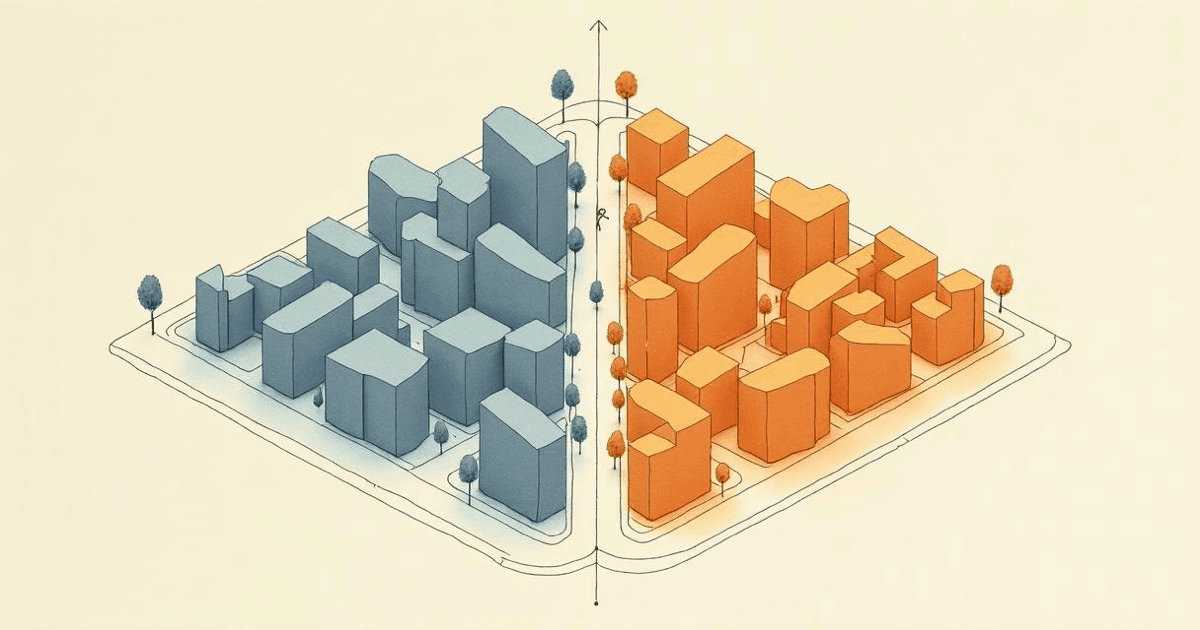
A rezoning — formally a zoning map amendment — changes the zoning district that applies to a property. It is a legislative act. An elected body amends the map by ordinance, and the new district's rules then govern what may be built and how.
That is a different kind of decision from every approval it gets confused with. A variance excuses one dimensional standard. A conditional use permits a listed use under conditions. Site plan review tests a layout against the rules already in force. A rezoning changes the rules themselves.
Direct answer: is a rezoning the right application?
Work through four questions before preparing anything:
- What use, density, height, or form does the project actually need, and does the current district prohibit it outright or merely constrain it?
- Is the proposed use listed in the current district as permitted or conditional? If it is, a rezoning is probably the wrong instrument.
- Does the jurisdiction's adopted plan already contemplate the district you want at this location — and does local law require that consistency?
- Who decides, on what criteria, and what happens to the property if the answer is no?
Question 2 is the one that saves the most money. Fairfax County, Virginia, describes a zoning map amendment as "one of the instruments by which a change in land use occurs" — one of several. If the ordinance already lists your use as conditional, the conditional use or special exception path is usually the correct and far lighter application.
Question 3 is the one that most often decides the outcome, and it is covered below.
Rezoning versus the approvals it is confused with
| Instrument | What it changes | Who typically decides | Key limitation |
|---|---|---|---|
| Rezoning / zoning map amendment | The district that governs the parcel | A legislative body, by ordinance | Legislative discretion; adoption is not guaranteed by meeting a checklist |
| Comprehensive plan map amendment | The adopted long-range land-use designation | Usually the governing body | May be a prerequisite to the rezoning, not an alternative to it |
| Variance | One dimensional standard, for one property | A board of adjustment or appeals | Cannot authorize a use the district does not allow |
| Conditional use / special exception | Permission for a use the ordinance already lists as eligible | A commission, board, or council | Only available for uses the district actually lists |
| Site plan review | Nothing — it tests a layout against current rules | Staff, or a planning body | Cannot approve what the zoning prohibits |
| Subdivision | Lot lines and the creation of parcels | A commission or council | Separate from the use question entirely |
| Building permit | Nothing about use or density | The building authority | Issued under whatever zoning is in force at the time |
Read the table as a sequence as much as a comparison. A project that needs a rezoning frequently needs several of the others afterward, in order.
The plan map usually governs the zoning map
The single most useful thing to establish early is whether the adopted long-range plan already supports the district you want, because in many jurisdictions the plan map constrains what the zoning map is permitted to become.
Portland, Oregon, states the relationship plainly: the Comprehensive Plan Map is the leading map and the Zoning Map is the following map — the zone map can catch up to the plan map, but it cannot go past it. Practically, Portland's official maps show some zones in parenthesis; where the desired zone appears in parenthesis, only a Zoning Map Amendment is required, and where it does not, a Comprehensive Plan Map Amendment and a Zoning Map Amendment are both required.
That is Portland's rule, not a national one. But the underlying question — does the adopted plan already contemplate this? — is worth answering in any jurisdiction before an application is drafted, because the answer usually determines whether you are filing one application or two, and whether staff will be able to recommend approval at all.
Current official examples
These are current, jurisdiction-labeled examples, checked against each authority's own page. They show how much the procedure moves between jurisdictions. They are not thresholds, deadlines, or criteria you can carry to another address.
- Madison, Wisconsin. A rezoning is used when an owner wants to use property in a way the current zoning does not permit. "To rezone, the Plan Commission must make a recommendation to the Common Council. The Council must then adopt an ordinance." Applicants must notify the district alderperson, city-registered neighborhood associations, and listed business associations at least 30 days prior to filing, and an application that misses that step is rejected. The city states its review process is approximately 10 to 12 weeks from receipt of the application to scheduled Common Council action.
- Austin, Texas. After the application packet is complete and the fee is paid, the city assigns a case manager as liaison. Within 14 days of filing, notice is mailed to property owners, utility customers, and registered environmental and neighborhood organizations within 500 feet, and a zoning sign is posted on site. Hearing notice is published and mailed no later than 16 days before the scheduled Council meeting. "Council may approve, deny, approve with conditions, or approve a different zoning classification," and an approval results in an ordinance requiring three readings.
- Fairfax County, Virginia. "The rezoning of land can only be approved by the Board of Supervisors." The process runs through pre-staffing comments, resubmission, and a staff report published two weeks prior to the public hearing, with draft proffers expected at resubmission and executed proffers recommended before the Board hearing.
- Portland, Oregon. Zoning Map Amendments and Comprehensive Plan Map Amendments are processed through a Type III procedure, a pre-application conference is required before submittal, and a Zoning Map Amendment consistent with the plan designation may be approved where adequate public services are capable of supporting the uses allowed by the zone, or will be by the time development is complete.
Four jurisdictions, four different decision-makers, four different notice regimes. Nothing about the shape of one transfers to another.
What the application usually has to establish
The forms differ, but the burden tends to fall in the same places:
- The requested district, precisely. Not "commercial" — the specific district, and the reason that district rather than an adjacent one.
- Consistency with adopted policy. Where the plan governs, this is the centre of the case rather than a formality.
- The land, described exactly. Legal description and mapping sufficient for an ordinance to attach to a defined area.
- Service and infrastructure capacity. Portland makes this an explicit approval criterion; elsewhere it may arrive through staff comment or agency review.
- The effect on surrounding property, in whatever terms local law actually uses. Read the ordinance's own factors rather than importing a generic list.
- What the applicant will commit to, where the jurisdiction allows conditions or proffers.
Notice requirements are part of the application, not an afterthought. Madison's 30-day pre-filing notification is a rejection condition, and Austin's 500-foot notice and posted sign run on their own clocks.
Conditions, proffers, and planned development
Many jurisdictions can attach commitments to a rezoning, and the mechanism has different names and very different legal weight from place to place.
Fairfax County uses proffers — commitments offered by the applicant, expected in draft at resubmission and recommended in executed form before the Board hearing. Austin's Council may approve with conditions, or approve a different classification than the one requested. Madison offers a Planned Development district for projects that do not fit conventional zoning: a site-specific solution with no predetermined requirements for land use, lot specifications, height, or parking, negotiated between the owner and the city.
Two things follow. First, whatever is committed generally binds the land, not the applicant — a later owner inherits it. Second, the commitments and the approved exhibits become part of what a future buyer, lender, or reviewer will read. Treat them as durable instruments, and keep them with the property record.
A practical rezoning sequence
1. Confirm the instrument before the application
Establish that the current district genuinely prohibits the use, and that no lighter path — conditional use, variance, or an administrative adjustment — reaches the same result.
2. Test plan-map consistency
Determine whether the adopted plan already supports the district, and whether a plan amendment is a prerequisite. In Portland this is a visible test on the official map; elsewhere it may require a policy reading.
3. Take the pre-application step where one exists
Portland requires a pre-application conference before a Type III submittal. Even where it is optional, it is the cheapest place to learn that the request will not be supported.
4. Complete the pre-filing outreach on its own clock
Madison's alderperson and neighborhood-association notification must happen at least 30 days before filing. Outreach deadlines that precede the application are easy to discover too late.
5. Assemble the legal description, mapping, and narrative
The narrative should address the jurisdiction's own stated review factors, in its own terms.
6. Work the staff review honestly
Staff comments are the substance of the case, not an obstacle course. Fairfax County publishes its staff report two weeks before the public hearing, which means the record is largely set before anyone speaks.
7. Prepare for the recommending body and the deciding body
They are usually different. Madison's Plan Commission recommends and the Common Council adopts. Fairfax County's Board of Supervisors alone can approve a rezoning.
8. Read the adopted ordinance and every condition
Check the district adopted, the land it attaches to, the conditions or proffers, and the approved exhibits — the decision may not match the request.
9. Plan the approvals that follow
A rezoning authorizes nothing to be built. Site plan review, subdivision, engineering, building and trade permits, and occupancy approval generally all still apply.
What a rezoning does not guarantee
This is the part most often misunderstood in a purchase or a pro forma.
A rezoning changes the district. It does not certify that a particular building fits on the parcel, that services have capacity, that access is adequate, that the site is free of easements, floodplain, shoreland or historic constraints, or that a later approval will go the applicant's way. Overlays commonly survive a base-district change untouched.
It also does not run in reverse. If a lawful existing building depends on the old district, confirm what the new district does to it before the map changes, not after.
And because it is a legislative act, satisfying every published criterion does not compel adoption. Austin's own description makes the range explicit: Council may approve, deny, approve with conditions, or approve a different classification altogether. Plan for the outcomes other than the one requested.
For a property you are evaluating rather than developing, the zoning on record and the use on the ground can diverge for reasons that have nothing to do with rezoning — see how to check building permit history before buying a house and zoning permits versus building permits.
Fees and timelines
There is no reliable national rezoning fee or processing-time range. Timing changes with plan-amendment prerequisites, pre-filing outreach, submittal calendars, staff review cycles, resubmissions, the recommending body's schedule, the legislative body's schedule, and any required readings.
Where a jurisdiction publishes its own figure, use that figure and label it. Madison states approximately 10 to 12 weeks from receipt to scheduled Common Council action; that is Madison's number for Madison, and it does not describe anywhere else. Budget separately for surveys, engineering, planning consultants, studies, notices, legal work, and every downstream approval.
Use Permit Check to organize the parcel, its current district, the responsible authority, and the approvals a project still depends on. Confirm every property-specific rule against current official sources before filing, buying, or building.
Frequently asked questions
What is a rezoning application?
It is a request to change the zoning district that applies to a property, decided as a legislative act. It is also called a zoning map amendment.
What is the difference between a rezoning and a variance?
A rezoning changes the district and its rules. A variance grants relief from a specific standard for one property and cannot authorize a use the district does not allow.
Do I need a rezoning if my use is already listed as conditional?
Usually not. If the ordinance lists the use as conditional in the current district, the conditional use or special exception path is normally the correct application.
Does the comprehensive plan control whether a rezoning can be approved?
In many jurisdictions it strongly constrains it. Portland describes the plan map as the leading map and the zoning map as following it, so a zone change beyond the plan designation requires a plan amendment as well.
Who approves a rezoning?
An elected or legislative body, after a recommendation. Madison's Plan Commission recommends to the Common Council, which adopts an ordinance; in Fairfax County only the Board of Supervisors can approve a rezoning.
Can conditions be attached to a rezoning?
Often, yes, under local law. Fairfax County uses proffers, Austin's Council may approve with conditions, and Madison offers a Planned Development district negotiated between the owner and the city. The commitments generally bind the land.
How long does a rezoning take?
There is no supported national figure. Use the jurisdiction's own published calendar — Madison, for example, states approximately 10 to 12 weeks from application receipt to Common Council action.
Do neighbors have to be notified?
Local law decides the method, radius, and timing. Austin mails notice within 14 days of filing to owners, utility customers, and registered organizations within 500 feet and posts a sign; Madison requires notification of the alderperson and registered associations at least 30 days before filing.
Does an approved rezoning let me start construction?
No. It changes the district. Site plan review, subdivision, engineering, building and trade permits, and occupancy approval can all still apply.
What happens if the rezoning is denied?
The current district continues to govern. Local law determines whether and when a similar request may be refiled, and a denial may reset the project to a design that works under existing zoning.
Sources
- Madison Rezoning
- Understanding Austin's Zoning/Rezoning Process
- Fairfax County Rezoning Process
- Portland Zoning Changes
- Portland Zoning and Comprehensive Plan Maps
Related GovCodex guides
Last reviewed: September 2, 2026. Requirements vary by jurisdiction and property.
What this permit is
Application to change the zoning classification of a property
Category: Zoning
Workflow: Legislative zoning action
Jurisdiction level: Municipal (City / Village / Town)
Public process for changing zoning text or a property's mapped district.
Also known as: Rezoning Application, Zoning Map Amendment, Zoning Change Application, Rezone Request, Zoning District Change, Map Amendment Application
What you need
- Map or text amendment application and owner authorization (Commonly required)
- Legal description and map of the land affected (Commonly required)
- Request narrative addressing adopted plans and locally required review factors (Commonly required)
This is a general workflow, not a finding about a particular property. Verify each locally marked item against the current official application, ordinance, and issuing department.
How to apply
- Confirm that an amendment, rather than a variance or conditional use, is the authorized path
- Prepare the application, map, legal description, and required planning narrative
- Complete staff review and the notice or hearing process required by governing law
- The authorized legislative body acts on the request after required recommendations
- If adopted, complete any follow-on development and building approvals (Commonly required)
Timing
Processing time is set by the responsible jurisdiction: follow its published application deadline, review calendar, and completeness rules.
Fees
Consult the responsible jurisdiction’s current application and fee schedule. No supported national fee range is available.
Official sources
These dated official sources support the workflow distinctions in this general guide. They do not establish the rules for your property; verify the current source published by your responsible authority.
- Rezoning — City of Madison Development Services Center (Madison, WI; checked 2026-09-02). Local example where the Plan Commission recommends and the Common Council adopts an ordinance, with alderperson and neighborhood-association notification required at least 30 days before filing.
- Understanding Austin's Zoning/Rezoning Process — City of Austin (Austin, TX; checked 2026-09-02). Local example of case-manager assignment, 500-foot notice and posted sign, and a Council that may approve, deny, approve with conditions, or approve a different classification.
- Rezoning Process — Fairfax County Department of Planning and Development (Fairfax County, VA; checked 2026-09-02). Local example where only the Board of Supervisors can approve a rezoning, with proffers expected in draft at resubmission and a staff report published two weeks before the hearing.
- Zoning Changes — Portland Permitting & Development (Portland, OR; checked 2026-09-02). Local example where the Comprehensive Plan Map leads the Zoning Map, a plan amendment may be required alongside the map amendment, and adequate public services are an approval criterion.
- Zoning and Comprehensive Plan Maps — Portland Bureau of Planning and Sustainability (Portland, OR; checked 2026-09-02). Local example stating that the zone map can catch up to the plan map but cannot go past it.
Related permits
Site Plan Review Application
Review of proposed development layout, parking, landscaping, and site design
Special Exception / Conditional Use Permit
Discretionary approval for a use the ordinance lists as eligible subject to applicable standards and conditions
Preliminary Subdivision / Development Plan
Application to divide land into multiple lots or develop a planned community