
Zoning Variance Application Guide
Learn when a zoning variance or adjustment may apply, which legal test controls, what evidence to prepare, and which approvals still follow.
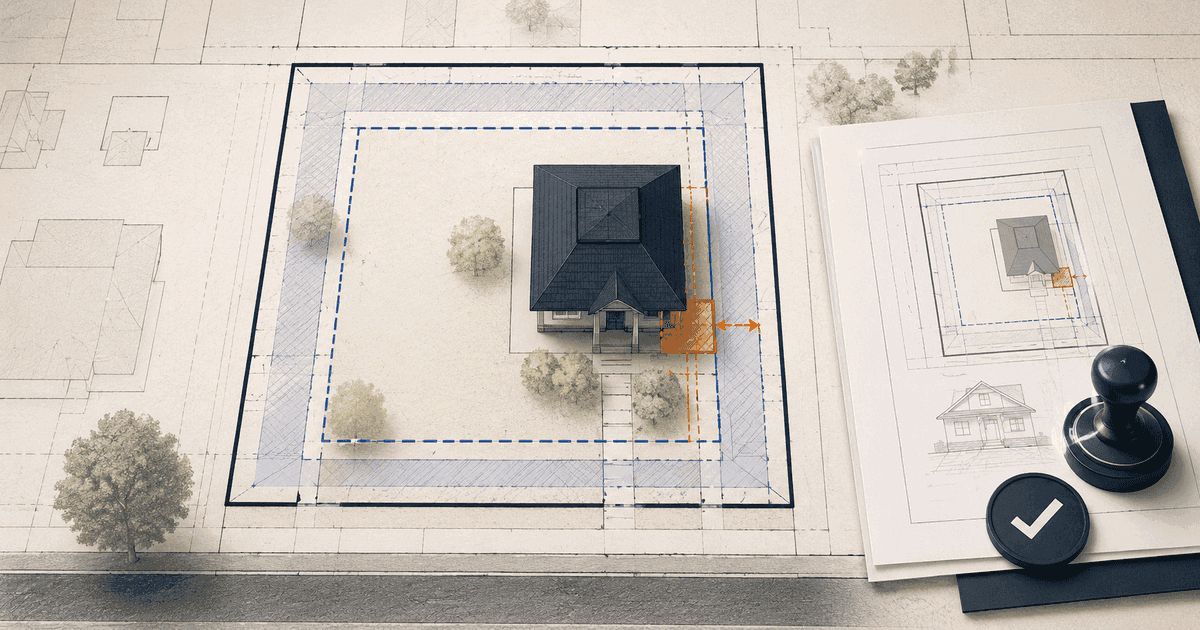
A zoning variance is targeted relief from a specific zoning standard under the legal test that applies in the property’s jurisdiction. It is not a national entitlement, a substitute for redesign, or approval of the entire project.
Start by identifying the exact rule the project cannot meet. Then verify whether the local code authorizes a variance, an administrative adjustment, a minor modification, or no relief at all. The name, decision-maker, findings, notice, hearing, fee, timeline, duration, and appeal path come from current state and local law.
Direct answer: when a variance may be the right path
A variance may be relevant when a proposed use is otherwise allowed but a parcel-specific condition prevents compliance with a dimensional or development standard such as a setback, height, lot coverage, frontage, or placement rule. That is only a screening question. The governing statute and ordinance decide whether relief is available and what must be proved.
Do not assume that every jurisdiction uses an “unnecessary hardship” test or that every variance goes to a zoning board. Minnesota municipalities use a statutory practical-difficulties test. Portland uses administrative adjustment procedures for specified standards. Fairfax County routes variances through its Board of Zoning Appeals. Madison publishes separate area- and use-variance findings.
Identify the exact relief before choosing the process
Write the request as a measurable comparison: the controlling ordinance section; required and proposed values; amount of relief; parcel condition; and plan sheet showing the conflict. The request should not be framed as general permission to build.
Use a current survey when the result depends on a lot line, recorded easement, ordinary high water mark, floodplain limit, or another surveyed feature. Public GIS can help with early screening, but approximate parcel geometry is not a boundary survey and should not be used to invent a setback or buildable envelope.
Variance, adjustment, conditional use, rezoning, and code variance
| Path | Main question | Important boundary |
|---|---|---|
| Zoning variance | May a particular zoning standard be modified under the governing relief test? | Does not approve construction or change every rule for the parcel. |
| Administrative adjustment or minor variation | Does the code authorize staff-level relief for this standard and request? | Availability, limits, findings, and appeal rights are local. |
| Conditional use or special exception | Is a use listed as conditionally eligible at this site? | Does not replace dimensional relief when separate relief is required. |
| Rezoning or map amendment | Should the parcel’s zoning classification change? | Legislative or policy review differs from property-specific relief. |
| Building-code variance or alternative | May a building-code requirement be modified or met another way? | Separate authority and safety review from zoning relief. |
| Zoning appeal or interpretation | Did an administrator misapply or interpret the code? | Challenges a decision; it is not automatically new relief. |
Some states prohibit using a variance to authorize a use the district does not allow. Minnesota’s municipal statute is a current example. Elsewhere, use variances may exist under a different and often stricter test. Verify the local remedy rather than importing terminology from another state.
Current official examples show why the legal test cannot be nationalized
| Jurisdiction | Current official path | Decision value |
|---|---|---|
| Minnesota municipalities | Section 462.357 uses practical difficulties: reasonable use, circumstances unique to the property and not created by the landowner, and no alteration of the locality’s essential character. Economic considerations alone are insufficient, and the statute bars a variance for a use not allowed in the zone. | “Unnecessary hardship” is not universal and a use variance is not universally available. |
| Portland, Oregon | Portland’s Type II Adjustment Review is an administrative staff decision. Applicants address the purpose statement for each standard, and one application can include multiple adjustments. | Not every relief request goes to a zoning board or public hearing. |
| Fairfax County, Virginia | Fairfax describes completeness review, agency circulation, revisions, notice, staff reporting, and a Board of Zoning Appeals hearing. The county states an approximately 90-day local process from acceptance to hearing. | A published local timeline applies only to that local workflow and starting point. |
| Madison, Wisconsin | Madison distinguishes area- and use-variance findings, requires specified plans, uses a Zoning Board of Appeals hearing, and says construction permits follow approval. | The legal test, submittal, hearing, and downstream permits must be read together. |
These examples were checked on August 30, 2026. They explain workflow differences; they do not establish a rule, fee, deadline, setback, or likely outcome for another property.
A practical application sequence
1. Confirm the authority and zoning record
Verify the parcel, responsible municipality or county, zoning district, overlays, prior approvals, nonconforming status, and any interpretation already issued. A mailing address or county name does not identify the zoning authority by itself.
2. Test a compliant redesign first
Move, shrink, rotate, or revise the project before paying for discretionary relief. Some legal tests consider whether reasonable use remains. A redesign record also helps show why the requested deviation is limited.
3. Retrieve the governing criteria and application
Use the current statute, ordinance, application, checklist, fee schedule, calendar, and notice instructions. Confirm whether a pre-application meeting is required and whether staff can authorize a smaller adjustment.
4. Build evidence around each finding
Crosswalk every required finding to a factual exhibit. Materials may include a survey, site plan, elevations, photographs, topography, easements, prior plats, drainage information, alternative layouts, and a concise narrative. Do not rely on personal convenience, project value, construction cost, or a neighboring variance unless the local criteria make it relevant.
5. File a complete and consistent package
Use the same dimensions and layout across the application, survey, plans, and narrative. Distinguish completeness comments from the merits decision.
6. Follow the local notice and decision procedure
The jurisdiction may use staff review, notice, posting, a hearing, a recommendation, a board decision, or some combination. Only promise the steps the current local procedure requires.
7. Read the written decision
Record findings, conditions, approved plans, effective date, expiration or establishment deadline, appeal information, and any recording requirement. A meeting vote may not be the final operative document.
8. Complete downstream permits
A variance normally resolves only the stated zoning conflict. Site-plan, building, trade, grading, driveway, environmental, fire, health, and occupancy approvals may still apply.
Evidence and property due diligence
A useful package makes the exact rule and amount of relief obvious, documents parcel features at the right precision, responds to every finding, and keeps the plans and narrative consistent. A drawing generated from synthetic or geocoder geometry cannot prove a property-unique condition. When inches or feet decide the result, obtain a current survey or other accepted evidence.
Do not assume an approval lasts forever or transfers unchanged. Review the decision and current code for deadlines, conditions, recording, abandonment, revocation, amendments, transfer rules, and the appeal path. For a property transaction, obtain the signed decision, approved exhibits, amendments, permit closeout records, and current written status.
Fees and timelines
There is no supported national variance fee or processing-time range. Cost and timing can depend on the relief type, completeness, calendar, notice, revisions, continuances, studies, appeals, and later permits.
Use the current local fee schedule and calendar. Fairfax County’s approximately 90-day statement is a named local example, not a national estimate. Do not carry the retired blog article’s generic 4–10 week range into project planning.
Use Permit Check to organize the parcel, project, responsible authority, likely zoning conflict, and downstream permits. Confirm every property-specific requirement against current official sources before filing or building.
Frequently asked questions
Is a zoning variance the same as a building permit?
No. A variance addresses specific zoning relief. A building permit evaluates construction and remains a separate downstream approval.
Does every state use an unnecessary-hardship test?
No. Minnesota municipalities use practical difficulties, while Madison’s Wisconsin example publishes separate area- and use-variance findings.
Can a variance allow a prohibited use?
It depends on governing law. Minnesota’s municipal statute bars that use of a variance. Other jurisdictions may authorize a distinct use variance or require rezoning.
Does every variance require a public hearing?
No. Portland’s current adjustment process includes administrative staff decisions for qualifying requests. Other jurisdictions use boards and hearings.
How long does a zoning variance take?
Use current local calendars and completeness rules. There is no supported national range. Fairfax County publishes an approximately 90-day local path from acceptance to its BZA hearing.
How much does a variance cost?
Use the responsible jurisdiction’s current fee schedule and account for surveys, plans, notices, studies, and downstream permits. No national fee applies.
Do I need a survey?
Often, when relief depends on a lot line, setback, easement, waterfront line, or another precise feature. Confirm the local application requirements.
Does an approved variance expire or transfer on sale?
Either can depend on the decision and local law. Review the written approval, conditions, deadlines, recording, amendment, and transfer rules.
Can neighbors veto a variance?
Comments may be part of the record, but the authorized decision-maker applies the governing criteria. Participation and appeal rights are local.
Can I build immediately after approval?
Not unless every separately required permit is issued and the decision is effective. Follow the approved plans, conditions, and permit sequence.
Sources
- Minnesota Statutes, section 462.357
- Portland Adjustment Reviews
- Fairfax County Variance Process
- Madison Zoning Variances
Related GovCodex guides
Last reviewed: August 30, 2026. Requirements vary by jurisdiction and property.
What this permit is
Request for relief from a specific zoning standard under the jurisdiction's applicable variance criteria
Category: Zoning
Workflow: Quasi-judicial relief
Jurisdiction level: Municipal (City / Village / Town)
Evidence-based request for relief from a specific rule under legally defined criteria.
Local path check: The governing statute and ordinance determine the decision-maker, legal standard, and whether a minor administrative path exists.
Also known as: Variance Application, Variance Request, Zoning Variance, Dimensional Variance, Use Variance, Area Variance, Setback Variance, Height Variance
What you need
- The exact ordinance provision and precise relief requested
- Evidence addressing the variance criteria in the governing statute and local ordinance
- Application, site plan or survey, narrative, and exhibits required by the official form (Commonly required)
This is a general workflow, not a finding about a particular property. Verify each locally marked item against the current official application, ordinance, and issuing department.
How to apply
- Identify the exact rule, requested deviation, and whether a variance is an authorized remedy
- Retrieve the applicable legal criteria; area, use, code, and environmental variances may use different tests
- Prepare the official application and evidence addressing each applicable criterion
- Complete notice and a hearing before the authorized decision-maker when governing law requires them (Commonly required)
- Receive findings and a written decision, including any conditions or deadlines (Commonly required)
- Complete any separate permits required for the underlying project
Timing
Processing time is set by the responsible jurisdiction: follow its published application deadline, review calendar, and completeness rules.
Fees
Consult the responsible jurisdiction’s current application and fee schedule. No supported national fee range is available.
Official sources
These dated official sources support the workflow distinctions in this general guide. They do not establish the rules for your property; verify the current source published by your responsible authority.
- Minnesota Statutes, section 462.357, subdivision 6 — Minnesota Office of the Revisor of Statutes (Minnesota municipalities; checked 2026-08-30). State example using a practical-difficulties test and prohibiting a variance from authorizing a use the district does not allow.
- Adjustment Reviews — Portland Permitting & Development (Portland, OR; checked 2026-08-30). Local example where Type II adjustment review is an administrative staff decision tied to the purpose of the standard.
- Variance Process — Fairfax County Planning Development (Fairfax County, VA; checked 2026-08-30). Local BZA example with completeness, agency, notice, revision, staff-report, and public-hearing steps; the county states an approximately 90-day local path.
- Zoning Variances — City of Madison Development Services Center (Madison, WI; checked 2026-08-30). Local example distinguishing area and use findings, public-hearing materials, and downstream construction permits.
Related permits
Site Plan Review Application
Review of proposed development layout, parking, landscaping, and site design
Special Exception / Conditional Use Permit
Discretionary approval for a use the ordinance lists as eligible subject to applicable standards and conditions
Rezoning Application / Zoning Map Amendment
Application to change the zoning classification of a property