
Demolition Permit Guide
Learn when demolition, wrecking, or raze permits apply; which hazardous-material, utility, historic, and site requirements come first; and why demolition does not authorize a rebuild.
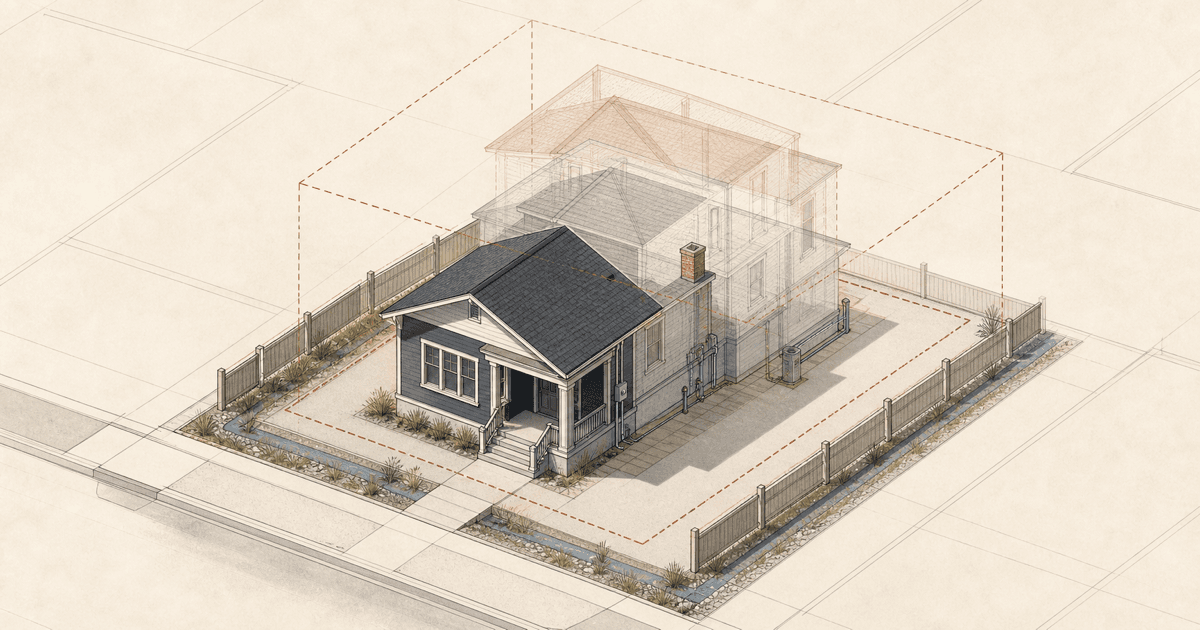
A demolition permit — a wrecking permit or raze permit in some jurisdictions — authorizes the removal of a structure. It is issued by a local building or development authority, and is almost never the only approval a teardown needs.
Two things surprise people. Partial removal often crosses the same threshold as full removal. And, more expensively, the permit says what may come down and nothing about what may go back up.
Direct answer: do you need a demolition permit?
Start with four questions.
- What is being removed, and how much? Whole building, one wing, or a majority of the exterior walls.
- Which authority controls demolition here? City, county, and often a separate state or regional air agency.
- What must happen before the permit issues? Hazardous-material screening, utility disconnects, historic review, site controls, notice, and sometimes a licensed contractor.
- What may lawfully be rebuilt afterward? Answer this before the building comes down.
Do not assume a small structure is exempt or that partial work escapes the process. Seattle requires a permit to remove a building, excepting only small accessory structures under 120 square feet. Portland states the trigger more broadly still — "You need a demolition permit for any structure that needed a permit to be built." Local rules, not national thresholds.
Demolition, partial demolition, deconstruction, and alteration
The words are used loosely in conversation and precisely in ordinances.
| Term | What it usually means | Why it matters |
|---|---|---|
| Total demolition | Removal of the entire structure | The clearest trigger, and most likely to require notice, screening, and closeout |
| Partial demolition | Removal of part of a structure, commonly measured against exterior walls | Frequently crosses the same threshold as a full teardown; the most missed requirement here |
| Major alteration | Substantial removal stopping short of the local demolition definition | May be permitted as construction instead, under a different application |
| Deconstruction | Taking a building apart by hand to salvage materials | Changes who may do the work and how long it takes, not just debris handling |
The line between "partial demolition" and "alteration" is set locally and is load-bearing. Austin applies demolition notification and a pre-demolition inspection fee to "total demolitions and partial demolitions, removing more than 50% of exterior walls." Portland uses the same measurement differently: "A demolition means removal of all exterior walls above the foundation," and removing 50% or more short of that is a major alteration. Same variable, different threshold.
Before you demolish, confirm what you may rebuild
This costs owners more than anything else on the page, and it is almost never on the permit checklist. Many existing buildings are lawful only because they predate the current zoning: the footprint sits inside today's setback, the height exceeds today's limit, the lot holds more units than today's density allows. Such buildings are typically protected as legal nonconforming — protected as they stand — and that protection frequently does not survive a voluntary demolition.
Portland's zoning code states the rule plainly: "When a structure or other development that has nonconforming elements is removed or intentionally destroyed, replacement structures and other development must comply with the development standards of the base zone, overlay zone and plan district." The same section draws the distinction that matters — a structure "partially or totally damaged by fire or other causes beyond the control of the owner" may be rebuilt on the same footprint. On residential density it is blunter: when such a structure is "intentionally damaged, destroyed or demolished by fire or other causes within the control of the owner, the nonconforming residential density rights are lost, and the new development must meet all development standards for the site."
Casualty loss and a demolition contract are not treated alike. That is Portland's code, not a national rule, but the logic — a right attached to a structure ends when the owner ends the structure — recurs nationwide under different wording.
The consequence is concrete. A duplex on a lot now zoned for one dwelling may come back as one house; a building three feet from the side line may come back at the current setback; a four-story building may come back at three. The answer arrives after the building is gone.
Before applying, get in writing the current district and overlays, whether any element of the existing building is nonconforming and what demolition does to it, and whether your intended replacement is approvable at the footprint, height, density, unit count, setbacks, coverage, and parking you are assuming — including whether it triggers site plan review or would depend on a variance.
Some jurisdictions make this a hard precondition. Seattle permits housing to be demolished only in defined circumstances — among them that "you have already been issued a permit for a new use or a new building at the site" — and states flatly: "You cannot demolish housing to create non-required parking."
Hazardous materials: the screening that comes first
Asbestos and lead can trigger federal, state, and local requirements. The federal asbestos rule discussed here has specific coverage limits, including residential exceptions; what follows describes questions to confirm, not methods, and authorizes nobody to assess or handle regulated material.
Confirm whether NESHAP applies before work. The federal Asbestos National Emission Standards for Hazardous Air Pollutants (NESHAP) applies to covered facilities and excludes most residential buildings of four or fewer units, subject to the rule's large-scale and project exceptions. For work that is subject to NESHAP, EPA states that "the regulations require a thorough inspection where the demolition or renovation operation will occur" before demolition or renovation begins. Portland separately requires "a copy of the pre-demolition asbestos survey" before issuing its permit. Confirm the applicable federal, state, and local inspection and credential rules with the delegated agency.
Notification is a separate duty for covered work. For operations subject to NESHAP, EPA describes notification to the delegated entity before demolition, or before renovations involving the specified threshold of regulated asbestos-containing material. Confirm with the delegated agency whether the project is covered and what notification it requires before scheduling equipment.
Removal is regulated work. EPA describes work practices for covered operations, including handling and disposal requirements for regulated asbestos-containing material. State and local law determines whether accredited or licensed professionals are required for the project; confirm that requirement before demolition begins.
Lead is a separate question with separate rules, and older buildings often present both. Portland makes the point in the negative: a structure can be excused from hand deconstruction when more than 50% of its framing is unsalvageable from fire, rot, or mold, but asbestos and lead-based paint do not qualify for that exemption.
Current official examples
Current, jurisdiction-labeled examples from each authority's own page. They are not thresholds you can carry elsewhere.
- Madison, Wisconsin. The Landmarks Commission determines whether a building has historic value; if it does, "the demolition must be reviewed and approved by the Plan Commission, as well as by City agencies." Submittals include a site plan of existing conditions, a Reuse and Recycling Plan meeting the requirement that projects recycle or reuse at least 70% of debris, a street tree report, and a sewer plug permit. The alderperson, neighborhood and business associations, and the demolition listserv must be notified before applying.
- Minneapolis, Minnesota. A wrecking permit is required to demolish a commercial building or a one- or two-family dwelling, and the work is not owner-optional: "You need to hire a licensed wrecking contractor."
- Austin, Texas. Notices to adjacent residential structures go up five to 10 business days before demolition activity, and residential structures 45 years or older require Historic Preservation Office review. Contractors must request disconnection of Austin Energy and Austin Water services, protected trees 19 inches or greater trigger tree review, erosion and tree protection are inspected before demolition begins, and affected projects must reuse or recycle at least 50% of construction debris.
- Portland, Oregon. Houses and duplexes fall under the deconstruction ordinance if "built in 1940 or earlier" or a historic resource needing demolition review, and must then be taken apart by a Certified Deconstruction Contractor who files pre- and post-deconstruction forms documenting all salvage. A mandatory 35-day delay can apply to one- or two-family demolitions in residential zones.
- Seattle, Washington. Demolition permits require "at least 15 days of rat abatement by a licensed pest control company immediately prior to the start of work." Plans must address construction stormwater control, shoring needs a separate permit, and tenant relocation rules apply where the building has tenants.
Five jurisdictions, five prerequisite stacks. Nothing about the shape of one transfers to another.
A practical demolition sequence
1. Confirm the authority and the definition
Identify the city, county, and any regional air agency, then read the local definition of demolition against your scope.
2. Resolve the rebuild question first
Establish what may be built on the cleared site under current rules, and whether demolition extinguishes anything the building relies on.
3. Commission the hazardous-material survey
Have the required inspection performed by a qualified professional, and confirm with the delegated air agency what notification applies.
4. Check historic and age-based review
Age thresholds trigger review in many cities — 45 years in Austin, 1940 or earlier in Portland, a Landmarks determination in Madison.
5. Arrange utility disconnects and capping
Electric, gas, water, sewer capping, and well or septic abandonment each have their own provider, form, and lead time.
6. Confirm contractor licensing
Verify the credential the ordinance names — licensed wrecking contractor, certified deconstruction contractor — not a general contractor's license.
7. Install site protection before anything moves
Erosion control, tree protection, fencing, dust control, and stormwater measures are commonly inspected before demolition begins.
8. Complete notice and any delay period
Neighbor notices, tenant notices, and delay periods run on clocks that start before, not during, the work.
9. Handle debris and complete closeout
Meet and document the local diversion or salvage requirement, then complete final inspections, backfill, grading, and stabilization.
Inspections, closeout, and the finished site
A demolition permit is not finished when the building is down. Expect a pre-demolition inspection of protective measures and a final inspection of the cleared site, with closeout commonly covering the foundation and basement, backfill, grading and drainage, capped utilities, right-of-way restoration, and site stabilization. Portland requires an approved post-deconstruction form before final inspections can be scheduled.
Permits also expire. Madison's is valid for six months, and once demolition begins it expires in 30 days. An unclosed permit follows the property and can complicate later approvals, including a future certificate of occupancy.
Due diligence when buying a teardown
If the plan is to buy a property and remove what stands on it, the decision depends on facts the listing will not contain: the zoning district and overlays, the standards applying to new development, a written answer on whether the existing structure is nonconforming and what demolition does to that status, the building's age and any historic review, permit and violation history, utility and septic or well records, and recorded easements. Where housing is involved, check whether local rules restrict its demolition at all, as Seattle's do.
Pull the permit record early — how to check building permit history before buying a house covers what it proves — and confirm which approvals the replacement needs, since building, zoning, electrical, and plumbing permits answer different questions and issue separately. The failure mode is buying for a rebuild that current zoning will not authorize.
Fees and timelines
There is no reliable national demolition permit fee or processing-time range. Cost and duration move with structure type and size, hazardous-material survey and abatement, historic review, notice and delay periods, deconstruction versus mechanical removal, utility scheduling, debris diversion, and closeout.
Where a jurisdiction publishes its own figures, use them and label them. Madison's permit is valid for six months and expires 30 days after demolition begins; Portland describes a mandatory 35-day delay in certain one- and two-family cases. Those are two cities' numbers for two cities.
Budget separately for the survey and any abatement, utility disconnects and sewer capping, well or septic decommissioning, salvage labor, disposal, site protection, backfill and grading, and the permits for what comes next.
Use Permit Check to organize the parcel, the responsible authority, the likely demolition path, and the approvals a replacement still depends on. Confirm every property-specific rule against current official sources before filing, buying, or demolishing.
Frequently asked questions
Do I always need a permit to tear down a building?
Assume yes and verify locally. Portland states you need a demolition permit "for any structure that needed a permit to be built," and Seattle requires one to remove a building, excepting small accessory structures.
Does partial demolition need a permit?
Often yes, and this is the requirement people most commonly miss. Austin applies demolition notification and a pre-demolition inspection fee to partial demolitions removing more than 50% of exterior walls.
Is a demolition permit the same as a wrecking or raze permit?
The same approval under different local names. Minneapolis issues a wrecking permit; Wisconsin municipalities including Madison use raze and demolition terminology.
Do I need an asbestos inspection before demolition?
For projects subject to NESHAP, EPA states the regulations "require a thorough inspection where the demolition or renovation operation will occur" before demolition or renovation begins. Confirm coverage, inspection, and credential requirements with the delegated agency.
Do I still have to notify anyone if the asbestos survey finds nothing?
Possibly, if the project is subject to NESHAP or a separate state or local rule. Confirm coverage and notification requirements with the delegated agency rather than assuming a clean survey resolves every obligation.
Can I demolish a building myself?
Local law decides. Minneapolis states you need to hire a licensed wrecking contractor, and Portland requires a Certified Deconstruction Contractor for houses and duplexes built in 1940 or earlier. Regulated hazardous-material work is separately restricted.
Will I be able to rebuild the same building?
Not necessarily, and this is the most important question here. Portland's code provides that when a structure with nonconforming elements "is removed or intentionally destroyed, replacement structures and other development must comply with the development standards of the base zone, overlay zone and plan district." Verify before demolishing.
What utilities have to be disconnected first?
Typically electric, gas, and water, with sewer capped and any well or septic system decommissioned. Portland requires sewer capping under the demolition permit and a separate septic decommissioning permit.
Do neighbors have to be notified before a demolition?
Where local law requires it. Austin places notices at adjacent residential structures five to 10 business days before demolition activity; Madison requires notification of the alderperson, neighborhood and business associations, and the demolition listserv before applying.
What happens to the site after the building is gone?
Closeout commonly covers foundation removal, backfill, grading and drainage, capped utilities, right-of-way restoration, site stabilization, and debris-diversion documentation, followed by a final inspection.
Sources
- EPA — Asbestos NESHAP overview
- EPA — Asbestos-containing materials and demolition
- Madison, WI — Demolition
- Minneapolis, MN — Wrecking permits
- Austin, TX — Demolition Permit
- Portland, OR — Residential demolition permits
- Portland, OR — Deconstruction permit requirements
- Portland, OR — Title 33 Chapter 33.258 Nonconforming Situations
- Seattle, WA — Demolition Permit %28Building%29
- Seattle, WA — Demolition of Housing
Related GovCodex guides
Last reviewed: September 2, 2026. Requirements vary by jurisdiction and property.
What this permit is
Required for demolishing or removing structures, including partial demolition
Category: Building
Workflow: Demolition permit
Jurisdiction level: Municipal (City / Village / Town)
Pre-demolition clearance, disconnection, removal, and site-closeout workflow.
Local path check: Check for environmental, historic, utility-disconnect, and waste-disposal approvals.
Also known as: Demolition Permit, Demo Permit, Demolition Application, Structure Removal Permit, Tear Down Permit, Razing Permit
What you need
- Demolition application identifying each structure and responsible contractor
- Utility, hazardous-material, historic, pest, or waste clearances listed by the jurisdiction (Required where the local code lists it)
- Site or demolition plan and restoration information when requested (Commonly required)
This is a general workflow, not a finding about a particular property. Verify each locally marked item against the current official application, ordinance, and issuing department.
How to apply
- Screen for environmental, historic, utility, and disposal prerequisites
- Submit the demolition application and jurisdiction-specific clearances
- Complete required utility disconnections and pre-demolition inspections (Required where the local code lists it)
- Perform authorized removal, dispose of materials lawfully, and complete site closeout
Timing
Processing time is set by the responsible jurisdiction: follow its published application deadline, review calendar, and completeness rules.
Fees
Consult the responsible jurisdiction’s current application and fee schedule. No supported national fee range is available.
Related permits
Building Permit
Required for new construction, major renovations, additions, and structural alterations
Stormwater / Erosion Control Permit
Required for stormwater management and erosion control measures
Excavation / Trenching Permit
Required for excavation, trenching, and underground utility installation