
Can I Build an ADU in Aurora, IL?
Aurora, IL has no published ADU ordinance — its own occupancy rules say single-family lots may not have apartments added. Here's what to confirm with the city before you plan a coach house or garage apartment.
Start with the property and project
An Aurora mailing address alone does not establish City jurisdiction. Permit Check independently resolves the address and governing authority before it applies Aurora sources to the project scope.
Check this property and project against Aurora permit requirementsFor an in-City, source-backed result, GovCodex can prepare unsigned owner-review drafts for supported fence, deck, shed, residential garage, and residential addition scopes. Pool questions may need more facts, and no Aurora pool draft is available.
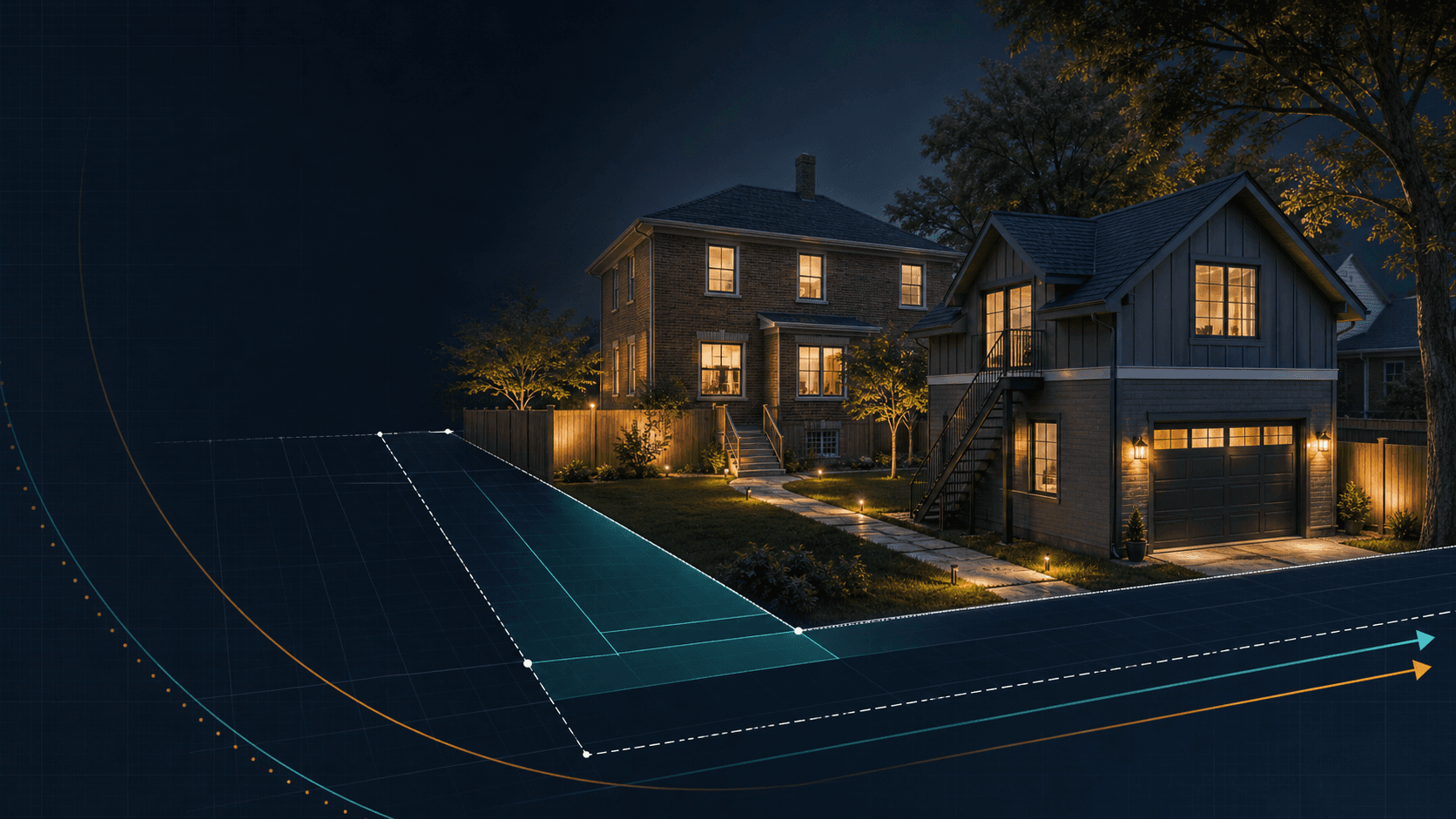
Direct Answer: Aurora, Illinois does not publish a stand-alone "accessory dwelling unit" ordinance the way some larger Illinois cities have started to. What the city does publish, on its own zoning and occupancy page, is more restrictive: single-family zoned property may not have an apartment added to it, and no apartment may be created in a basement or attic. That means a coach house, garage apartment, or backyard cottage with its own kitchen and living space is not a routine, by-right project in Aurora's single-family districts — it's a question to put directly to Planning and Zoning (630-256-3080) before you design anything, because the answer depends on your specific zoning district and lot.
Verified against official municipal and state sources: July 13, 2026. Requirements change — confirm with the city before applying.
Key Takeaways
- Aurora's Zoning & Occupancy Standards page states, under the city's Property Maintenance Code, that "property zoned single family may not have apartments added" and that apartments "may not be established in the basement or attic of any residence."
- Aurora's zoning code — the Code of Ordinances, hosted on Municode and mirrored on aurora-il.municipalcodeonline.com — is the controlling document for what's allowed by zoning district, but the city doesn't publish a plain-language ADU summary, so district-by-district rules have to be confirmed with staff.
- Zoning questions in Aurora go to Planning and Zoning at 630-256-3080; building-permit questions go to the Division of Building and Permits at 630-256-3130 — two different offices for two different pieces of an ADU project.
- Illinois has no statewide ADU mandate. A pending bill, HB 1813 (the Accessory Dwelling Unit Permissibility Act), would bar municipalities from banning ADUs outright, but it remained in committee as of mid-2026 and is not yet law — see Illinois building codes, explained for how home rule shapes this.
- Any new or altered detached structure in Aurora — garage, shed, or a converted carriage house — needs a building permit regardless of whether it also functions as living space; see the city's Permit List.
- If your property sits in one of Aurora's historic districts, altering or adding to an existing carriage house also requires review by the Historic Preservation program, separate from the zoning and building-permit process.
The Practical Rule
Don't confuse Aurora, Illinois with Aurora, Colorado when researching this online — the two cities share a name, both have modernized development codes, and search engines routinely blend the two. Aurora, Colorado's Unified Development Ordinance spells out a detailed detached-ADU allowance with specific size and height numbers; that ordinance has no bearing on a property in Aurora, Illinois, even though it's easy to find while searching "Aurora ADU rules." For Aurora, Illinois, the only specific, published statement GovCodex could verify points the other direction: the city's own Property Maintenance Code guidance says single-family zoned property may not have an apartment added, full stop, and explicitly rules out finishing a basement or attic into one. Whether a detached backyard structure with its own kitchen and bath would be treated as a prohibited "apartment" in a single-family district, or whether some of Aurora's other residential or mixed-use districts treat it differently, is a zoning-code question the city hasn't summarized publicly — it requires a direct inquiry tied to your specific parcel and zoning district.
What to Check Before You Build
- Confirm your zoning district first, before planning anything specific. Aurora's residential districts (single-family, two-family, multi-family, and the mixed-use districts near the historic core) aren't all treated the same way, and only Planning and Zoning (630-256-3080) or the city's Zoning and Planning office can tell you what applies to your specific lot.
- Ask the direct question: is a second dwelling unit permitted, and under what process — permitted use, conditional/special use requiring a public hearing, or not permitted at all. Don't assume a coach house or garage apartment is routine just because the structure itself (a garage) is common on the block.
- Check whether your property is in a historic district. Aurora's Historic Preservation program reviews exterior work on designated landmark and district properties, including garages, carriage houses, and other outbuildings, separately from zoning and building permits — see Historic Preservation.
- Plan for a building permit either way. Any new detached structure, or any addition to or conversion of an existing garage or carriage house, needs a permit from the Division of Building and Permits, independent of the zoning question.
- Check your HOA and lot-specific documents. Aurora doesn't verify or enforce private HOA covenants, so a project the city allows can still be blocked by a subdivision's private restrictions.
What Aurora's Zoning and Property Maintenance Rules Actually Say
The clearest, most citable statement Aurora publishes on this topic isn't a zoning handout — it's on the city's Zoning & Occupancy Standards page, maintained by the Division of Property Standards (630-256-3770) under the Aurora Property Maintenance Code. It states that property zoned single-family "may not have apartments added" and that "apartments may not be established in the basement or attic of any residence." That's an occupancy-standards statement rather than a zoning-district-by-district table of ADU rules, but it signals the city's default posture toward adding a second housing unit on a single-family lot is restrictive, not permissive.
The zoning code itself — the source that would define district-specific uses, lot coverage, setbacks, and any conditional-use path for a second unit — lives in Aurora's Code of Ordinances, published through Municode and mirrored on aurora-il.municipalcodeonline.com. Both platforms require a live, browser-rendered session to search, and the city doesn't maintain a plain-language ADU summary page the way it does for fences or general permits. That's why this article doesn't quote specific size, height, or setback numbers for an Aurora ADU: GovCodex could not independently verify them against the ordinance text itself, and repeating unverified numbers pulled from third-party sites — some of which actually describe Aurora, Colorado's ordinance rather than Aurora, Illinois's — would be worse than telling you plainly to confirm with the city.
Historic Districts and Existing Carriage Houses
Aurora has several designated historic districts and individual landmarks, overseen by the Aurora Preservation Commission and administered through the city's Historic Preservation program. A number of the district's late-19th- and early-20th-century properties already have a literal carriage house or coach house on the lot — a legacy accessory structure originally built for horses and carriages, often converted to a garage over the decades. The city's Historic Preservation Guidelines index design guidance covering, among other topics, additions and alterations to existing garages, carriage houses, and other outbuildings. Exterior work on a designated landmark or district property, including converting or expanding a carriage house, is reviewed by the Preservation Commission in addition to any zoning approval and building permit. If you're looking at a historic-district property with an existing carriage house, start with Historic Preservation staff before Planning and Zoning, since design review can shape what's feasible before you ever reach the zoning question.
Frequently Asked Questions
Is Aurora, Illinois the same as Aurora, Colorado for zoning purposes?
No. They are unrelated cities with separate codes, departments, and websites. Aurora, Colorado's Unified Development Ordinance includes a detailed detached-ADU allowance; that ordinance does not apply to any property in Aurora, Illinois. Confirm you're reading the Illinois city's own Code of Ordinances — via Municode or aurora-il.municipalcodeonline.com — before relying on any specific ADU number found online.
Can I just convert my existing garage into an apartment in Aurora?
Not without confirming it's allowed first. Aurora's published guidance says single-family zoned property may not have an apartment added, so a garage conversion that creates independent living space — kitchen, bathroom, separate entrance — is exactly the kind of project you need to clear with Planning and Zoning before starting. See can I convert my garage into an apartment (ADU) for how that conversion path generally works in cities that do allow it, then confirm Aurora's answer for your specific address.
Does Illinois require cities to allow ADUs?
Not yet. HB 1813, the Accessory Dwelling Unit Permissibility Act, would prohibit Illinois municipalities from banning ADUs outright while still letting them regulate size and location. It remained pending in the General Assembly as of mid-2026 and has not taken effect statewide. For the bigger picture of how Illinois home rule shapes local codes generally, see Illinois building codes, explained and ADUs in 2026: the complete state-by-state legal breakdown.
Who do I actually call to find out if my lot allows a second unit?
Planning and Zoning at 630-256-3080 for the zoning-district question, and the Division of Building and Permits at 630-256-3130 once you know a permit is needed. If your property is in a historic district, loop in Historic Preservation staff through the same Zoning and Planning office.
What if I want a documented answer, not just a phone call?
Aurora's Zoning and Planning division lists a formal land-use inquiry process for exactly this kind of question — a determination tied to your specific parcel rather than a general answer. Start through the Zoning and Planning page and ask staff to point you to the current process.
Verify Your Address
ADU rules turn entirely on your parcel's zoning district, and Aurora hasn't published a plain-language summary the way it has for fences or general permits — so a generic answer isn't good enough here. Before you spend money on plans, run a permit check or review GovCodex's Aurora permit catalog, and see the Aurora, IL building permit guide for how the city's broader permit and zoning process works.
Related Articles
Do You Need a Permit to Pour Concrete? Patios, Slabs & Walkways
Pouring concrete may be permit-exempt or regulated depending on whether it is a patio, slab, walkway, driveway, structural base, or right-of-way work.
Do You Need a Permit for an EV Charger?
Learn when a home EV charger needs an electrical permit, when panel or service upgrades enter the project, and how inspection and utility coordination work.
Do You Need a Permit for a Kitchen Remodel?
Learn when cabinets, sinks, islands, appliances, walls, wiring, plumbing, gas, or ventilation can change kitchen-remodel permit and inspection needs.