
Bloomington, MN Building Permit Guide (2025-2026)
How to get a building permit in Bloomington, Minnesota: which department issues permits, what's exempt, zoning setbacks, ADU rules, fees, contractor rules, and inspections.
Direct Answer: The City of Bloomington's Building and Inspections Division, part of the Community Development Department, issues every building, electrical, plumbing, mechanical, and trade permit inside city limits, applying the statewide Minnesota State Building Code (2020 edition) rather than a Bloomington-specific building code. All applications go through the city's CityView-based online permit portal — Bloomington no longer accepts paper applications — and most construction projects also have to satisfy Chapter 21 (Zoning and Land Development) of the City Code, enforced by the Planning Division, for setbacks, accessory structures, and land use. Homeowners who homestead (live in) their own home may pull permits and do the work themselves; everyone else needs a state- or city-licensed trade contractor.
Verified against official City of Bloomington and Minnesota Department of Labor and Industry sources: July 13, 2026. Requirements change — confirm with the Building and Inspections Division before applying.
Key Takeaways
- The Building and Inspections Division, part of the Community Development Department, issues every building, electrical, plumbing, and mechanical permit in Bloomington and enforces the Minnesota State Building Code (2020 edition) rather than a city-written code.
- Bloomington accepts permit applications only through its online CityView portal (shortcut blm.mn/portal) — paper applications aren't accepted, and new users must register an account first.
- The 2020 MN State Building Code's exempt-work list — small detached sheds under 200 sq ft, fences 7 feet or under, retaining walls under 4 feet, unattached decks under 30 inches high, and several other categories — doesn't need a building permit; nearly everything else does. See the city's Frequently Asked Questions page for the full list.
- Homeowners who homestead (live in) their own home may pull permits and perform the work themselves; non-owner-occupied and rental properties must hire a licensed contractor, per the Building and Inspections FAQ.
- Zoning setbacks for single-family lots run through Chapter 21 of the City Code, and Bloomington's front-yard rule can require more than the district minimum if neighboring homes already sit farther back — the city's "prevailing setback" provision.
- Trade permits are commonly priced as a percentage of project valuation with a stated minimum (often $55 for residential work), while roofing, siding, and some electrical categories carry flat dollar fees; see Permit Information and Fees.
- Every permit expires 180 days after issuance (extended from the date of each passed inspection), except roofing/siding permits, which run a full year, per the FAQ.
Scope note: This article covers permitting inside the City of Bloomington, Minnesota only. Neighboring Richfield, Edina, Eden Prairie, Burnsville, and Minneapolis each run their own building department, fee schedule, and zoning code, even though every Minnesota city enforces the same statewide building code.
Which Department Issues Permits in Bloomington?
The Building and Inspections Division sits inside the Community Development Department at Civic Plaza, 1800 W. Old Shakopee Road, Bloomington, MN 55431. The division reviews plans, issues permits, performs field inspections, licenses HVAC/mechanical/fuel-gas contractors, and runs the city's Time-of-Sale housing inspection program for one- and two-family homes, townhomes, condos, and mobile homes offered for sale. General permit questions go to 952-563-8930 or Inspections@BloomingtonMN.gov; plan-review questions go to PlanReview@BloomingtonMN.gov. Office hours are Monday–Friday, 8 a.m.–4:30 p.m.
Zoning, land use, and site-plan questions instead go to the Planning Division at 952-563-8920 or planning@bloomingtonmn.gov. The two divisions review different parts of the same project — Building and Inspections checks the construction against the state building code, while Planning checks the proposal against Chapter 21 (Zoning and Land Development) of the City Code — so a project that clears one review can still need sign-off from the other.
What Building Code Applies in Bloomington?
Minnesota does not let individual cities write their own residential or commercial building code the way some states do; see the Minnesota state building code, explained for the statewide framework. Bloomington adopts and enforces the code exactly as the state Department of Labor and Industry (DLI) writes it — currently the 2020 Minnesota State Building Code, effective March 31, 2020, which incorporates the International Building, Residential, Mechanical, and Fuel Gas Codes with Minnesota-specific amendments. DLI's Construction Codes and Licensing Division maintains the code statewide; Bloomington's Building and Inspections Division is the local authority that reviews plans and issues permits under it. This is why Bloomington's exempt-work list, described below, comes straight from the state code rather than a locally written ordinance.
What Work Requires a Permit — and What's Exempt?
Bloomington's Frequently Asked Questions page publishes the 2020 MN State Building Code's exempt-work list verbatim. According to that page, no building permit is required for:
- One-story detached accessory structures (tool sheds, playhouses, and similar uses) with floor area of 200 sq ft or less.
- Fences not over 7 feet high (though the city still recommends checking zoning setbacks with Planning at 952-563-8920 for a fence of any height).
- Retaining walls not over 4 feet high, measured from the bottom of the footing to the top of the wall, unless they support a surcharge or impound Class I, II, or III-A liquids.
- Water tanks on grade up to 5,000 gallons, with a height-to-diameter ratio no greater than 2 to 1.
- Sidewalks and driveways that aren't part of an accessible route.
- Decks and platforms not more than 30 inches above adjacent grade, not attached to a structure, and not on an accessible route.
- Painting, papering, tiling, carpeting, cabinets, countertops, and similar finish work.
- Above-ground prefabricated pools up to 5,000 gallons and 24 inches deep.
- Window awnings that project no more than 54 inches from the wall and need no additional support.
- Swings and other playground equipment.
- Soffits, fascia, and gutters (confirmed separately on the FAQ page).
Everything else needs a permit, including: new construction, additions, and remodels; attached decks or detached decks over 30 inches high; roofing or siding work covering more than one square (100 sq ft); new or replacement driveways; pools or spas deeper than 24 inches; and moving a structure into, within, or out of the city. Most electrical, plumbing, and HVAC work also needs its own trade permit, even inside an already-permitted project.
How Do I Apply for a Bloomington Building Permit?
- Confirm your property is inside Bloomington city limits. The city borders Richfield, Edina, Eden Prairie, Burnsville, and Minneapolis, and a Bloomington mailing address doesn't guarantee the parcel is inside the city.
- Register for an account on the CityView online portal (shortcut blm.mn/portal) using the city's registration instructions — complete account verification on a desktop or tablet, not a mobile device, or verification can fail.
- Gather your documents: a lot survey or site plan showing the work's location and dimensions, construction drawings for anything structural (decks, additions, garages), and the license information for every contractor involved.
- Submit the application and pay fees online, by credit card (Visa, Mastercard, American Express, Discover) or by check payable to the City of Bloomington.
- Respond to plan review, if the project needs it; direct questions to PlanReview@BloomingtonMN.gov. Plan review fees add 10% of the permit fee once job valuation exceeds $50,000 on HVAC and plumbing permits.
- Schedule inspections as work proceeds by calling 952-563-8930 — for example, an electrical rough-in inspection must happen before the house-wrap inspection, which in turn must happen before siding goes on.
- Track status and pull final results through the portal's Permit Status and Inspection Results lookup. Remember that permits expire 180 days after issuance unless extended by a passed inspection (roofing/siding permits run a full year).
What Does a Bloomington Permit Cost?
Bloomington bases most building-related fees on the project's job valuation (cost of labor and materials), with a state surcharge of valuation × 0.0005 added on top; several trade categories instead use flat fees. The numbers below come from the city's Permit Information and Fees page and Frequently Asked Questions:
| Permit / trade | How the fee is set | Minimum or flat fee |
|---|---|---|
| Building permit (new home, addition, remodel) | Based on job valuation, per the city's fee schedule | Varies by valuation |
| Residential electrical — complete new dwelling wiring | Flat fee | $150 |
| Residential electrical — new/upgraded service | Flat fee | $55 |
| Residential electrical — rewiring/remodel | $55 first room, $10 each additional room | $55 minimum, $150 max |
| HVAC / mechanical | 1.5% of job valuation + state surcharge | $55 residential / $65 commercial |
| Plumbing | 2% of job valuation + state surcharge | $55 residential / $65 commercial |
| Residential roofing | Flat fee | $100 |
| Residential siding | Flat fee | $150 |
| Residential roofing + siding combined | Flat fee | $250 |
| Time-of-Sale inspection (city inspector) | Flat fee | $250 |
Because the underlying valuation-based fee schedule is revised periodically, pull the current Permit Information and Fees page for a new construction or addition estimate rather than assuming a fixed percentage stays constant year to year. For general background on how cities typically structure these fees, see how much does a building permit cost.
What About Zoning, Setbacks & Overlay Districts?
Passing building-code review doesn't automatically satisfy zoning. Chapter 21 (Zoning and Land Development) of the City Code sets use, density, and yard requirements by district, and § 21.301.02 (Structure Placement) and § 21.302.07 (Single-Family Residential Standards) set the actual numbers. In the city's R-1 and RS-1 single-family districts, the minimum front-yard setback is 30 feet — but Bloomington also applies a "prevailing setback" rule: if the established pattern of homes on that block already sits farther back than 30 feet, the larger prevailing distance controls instead. Side yards run 5 feet, rear yards run 5 feet, and a side yard next to a public street (a corner-lot condition) runs 30 feet. The R-1A district uses a 75-foot front setback. Because setbacks are zone- and block-specific, confirm your parcel's district and exact figures with the Planning Division (952-563-8920) before designing a project — see also our general explainer on what a zoning setback actually is.
Detached accessory buildings — sheds and detached garages — follow § 21.301.19 (Accessory Buildings): non-garage accessory structures top out at 15 feet in height, and where a garage's sidewall exceeds 9 feet, the side and rear setbacks increase 2 feet for every foot (or portion of a foot) over 9. Bloomington also scales the maximum footprint of a detached accessory building to the size of the lot rather than using one flat number citywide; see the city's Accessory Buildings information sheet and Garage/Accessory Building information sheet for the exact calculation on your lot.
Bloomington also carries two overlay districts tied to the Minnesota River corridor: the Flood Hazard (FH) Overlay District, which adopts the FEMA Flood Insurance Rate Map for Hennepin County, and the Bluff Protection (BP) Overlay District, which covers land along the Minnesota River Bluff and any natural slope of 18% or greater over a 25-foot run. Properties in either overlay face additional review beyond the standard zoning district rules, including for fences — a fence within a floodplain or within 10 feet of the ordinary high-water level needs its own review from Building and Inspections.
Can I Build an Accessory Dwelling Unit (ADU) in Bloomington?
Bloomington allows accessory dwelling units under § 21.302.03 (Accessory Dwelling Units) of the City Code. Attached and internal ADUs — a unit built onto or carved out of the primary single-family home — are allowed by right in the applicable residential districts. A 2022 code amendment (Ordinance 2022-39) expanded the ordinance to also allow detached ADUs and revised the parking standards. The code caps ADU floor area at 300 to 1,000 square feet and at no more than 33% of the primary home's four-season living area (with up to 100 sq ft of shared mechanical/utility space excluded from that calculation), and it requires the property to be served by municipal sewer and water. An ADU still needs site plan approval from the Planning Division and a building permit from Building and Inspections — it isn't a use you can add without going through both reviews. For the bigger statewide and national picture on ADU rules, see accessory dwelling units in 2026: the complete state-by-state legal breakdown, then confirm Bloomington's current standards against § 21.302.03 or by calling Planning at 952-563-8920, since ADU ordinances are amended more often than most zoning rules.
Do I Need a Licensed Contractor?
It depends on occupancy and trade. A homeowner who homesteads (lives in) the property may apply for and personally perform building, electrical, plumbing, or HVAC work on that home. Owners of non-owner-occupied property — rentals, investment properties, and places of business — must hire a licensed contractor for any of that work; self-performing isn't allowed once the home isn't homesteaded, per the Building and Inspections FAQ.
Trade licensing itself splits between the city and the state. Bloomington's Building and Inspections Division licenses contractors performing mechanical, HVAC, and fuel-gas work locally. Electrical and plumbing contractors, along with most other trades, are licensed by the Minnesota Department of Labor and Industry, which also runs a public Contractor License Lookup and an enforcement-actions database. Bloomington doesn't maintain its own list of approved contractors, but the Building and Inspections Division can confirm whether a given contractor has previously pulled permits in the city.
Inspections & Permit Duration
Once a permit is issued, work proceeds through the inspections tied to that scope — footing/foundation, framing, rough-ins, and a final inspection, plus project-specific steps like a house-wrap inspection (required before siding goes on and after the electrical rough-in) or a pin- or helical-pier torque report for certain deck footings. Schedule inspections by calling 952-563-8930.
Every permit Bloomington issues expires 180 days after issuance, but each passed inspection resets that 180-day clock from the inspection date rather than the original issue date. Exterior work — roofing and siding — gets a longer window: those permits expire one year after issuance. A refund is available if work hasn't started, as long as the written request reaches Building and Inspections within 60 days of issuance. Separately, the city's Time-of-Sale (TOS) Housing Inspection Program requires an inspection — by a city inspector for $250, or by an independent licensed evaluator — before any change of ownership on a single- or two-family home, townhome, condo, or mobile home, regardless of whether it's formally listed for sale. Construction itself is limited to 7 a.m.–10 p.m. on weekdays and 9 a.m.–9 p.m. on Saturdays.
Frequently Asked Questions
Does Bloomington require a permit for a small backyard shed?
Not if it's a one-story, detached, tool/storage-type structure of 200 square feet or less — that's exempt under the state code's list, published on the city's FAQ page. Anything larger needs a building permit; check the Accessory Buildings information sheet for setback and height limits either way.
Do I need a permit to build a fence in Bloomington?
Only if it's taller than 7 feet — that triggers a building permit. A shorter fence is exempt from the permit itself, but the city still recommends calling the Planning Division (952-563-8920) to confirm zoning setbacks before installing a fence of any height, and fences in a floodplain or near the Minnesota River's ordinary high-water level need separate review. For the general mechanics of fence rules, see fence permit rules, height, and setbacks.
Can I do my own electrical or plumbing work in Bloomington?
Yes, if you homestead (live in) the home — you may apply for and perform building, electrical, plumbing, or HVAC work yourself. If the property is a rental or otherwise not owner-occupied, only a state-licensed contractor may do that work.
What building code applies to a new house in Bloomington?
The 2020 Minnesota State Building Code, enforced locally by the Building and Inspections Division. Minnesota doesn't allow cities to substitute their own residential building code, though local zoning under Chapter 21 still applies on top of it.
How long is a Bloomington building permit good for?
180 days from issuance, extended to 180 days from the date of the most recent passed inspection. Roofing and siding permits are the exception and run a full year from issuance. Extensions beyond that need building official approval.
Is a deck permit different from a building permit in Bloomington?
No — decks use the same building permit process. A permit is required for any attached deck or any detached deck more than 30 inches above grade, and the application needs a lot survey plus deck construction plans; see the city's Residential Decks Information Sheet for footing, joist, and railing specifics.
Does this guide apply to Richfield, Edina, or Eden Prairie?
No. Bloomington's neighboring cities each run their own building department, fee schedule, and zoning code, even though every Minnesota city enforces the same statewide building code described above.
Verify the Rules for Your Property
Permit exemptions, zoning setbacks, and fees depend on your parcel's exact address, zoning district, and project scope, and Bloomington updates its fee schedule and ordinances over time. Before you apply, check GovCodex's Bloomington permit catalog for the current permit types tied to your project, or run a permit check to see what your specific address and project actually require.
Related Articles
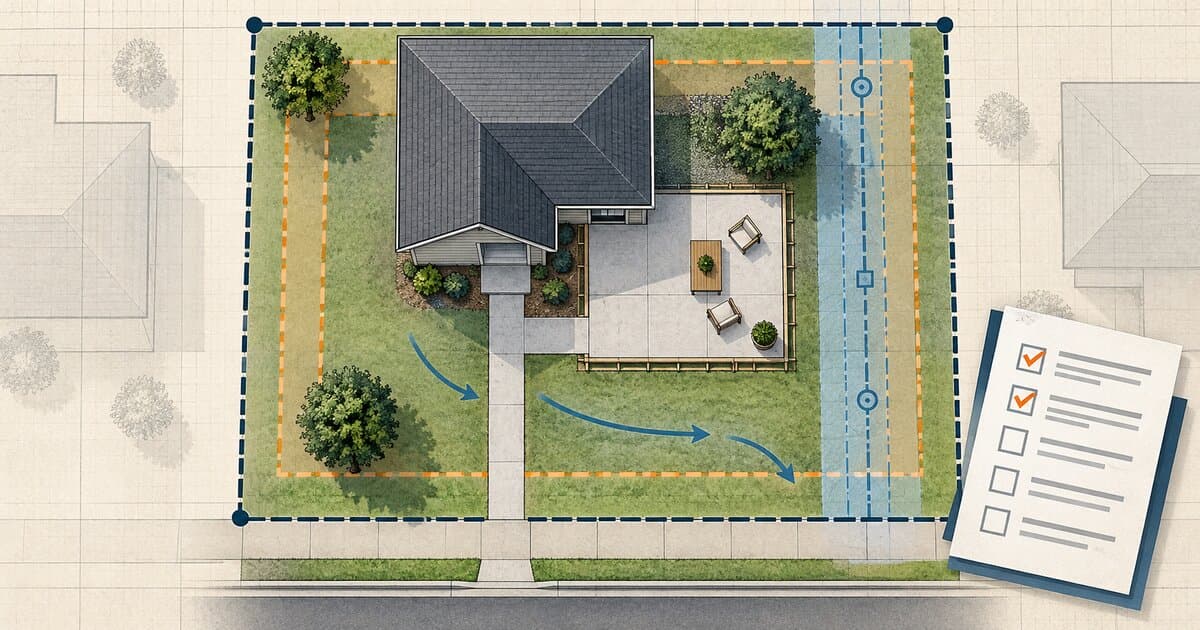
Do You Need a Permit to Pour Concrete? Patios, Slabs & Walkways
Pouring concrete may be permit-exempt or regulated depending on whether it is a patio, slab, walkway, driveway, structural base, or right-of-way work.
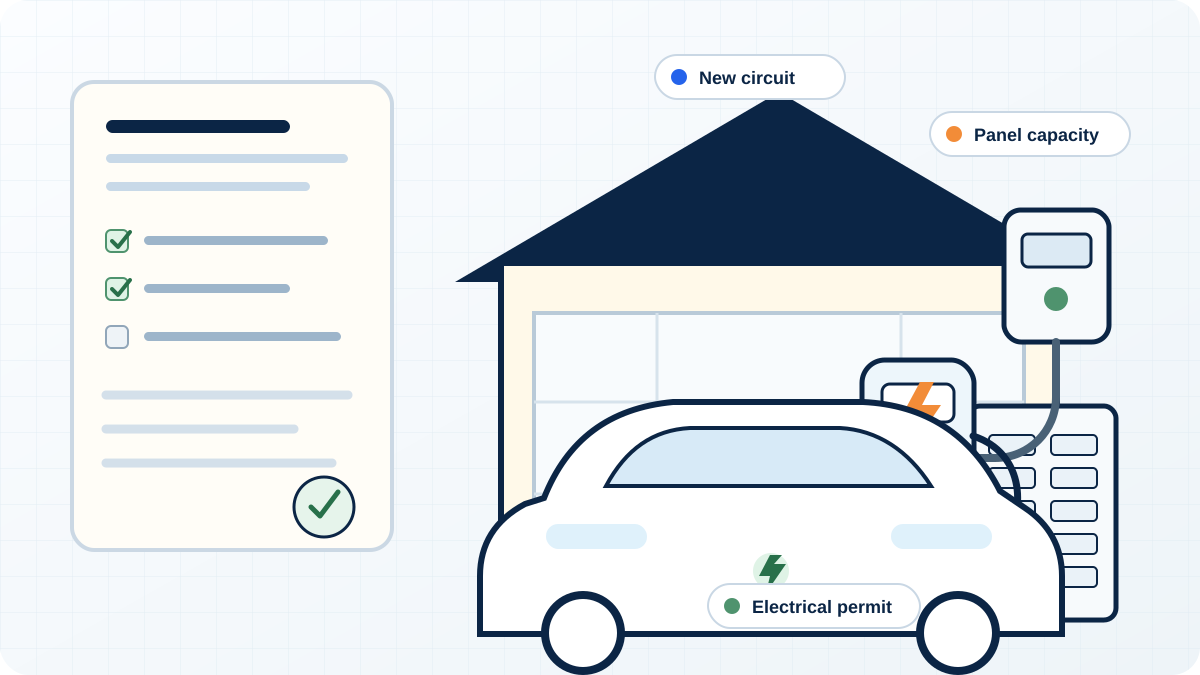
Do You Need a Permit for an EV Charger?
Learn when a home EV charger needs an electrical permit, when panel or service upgrades enter the project, and how inspection and utility coordination work.
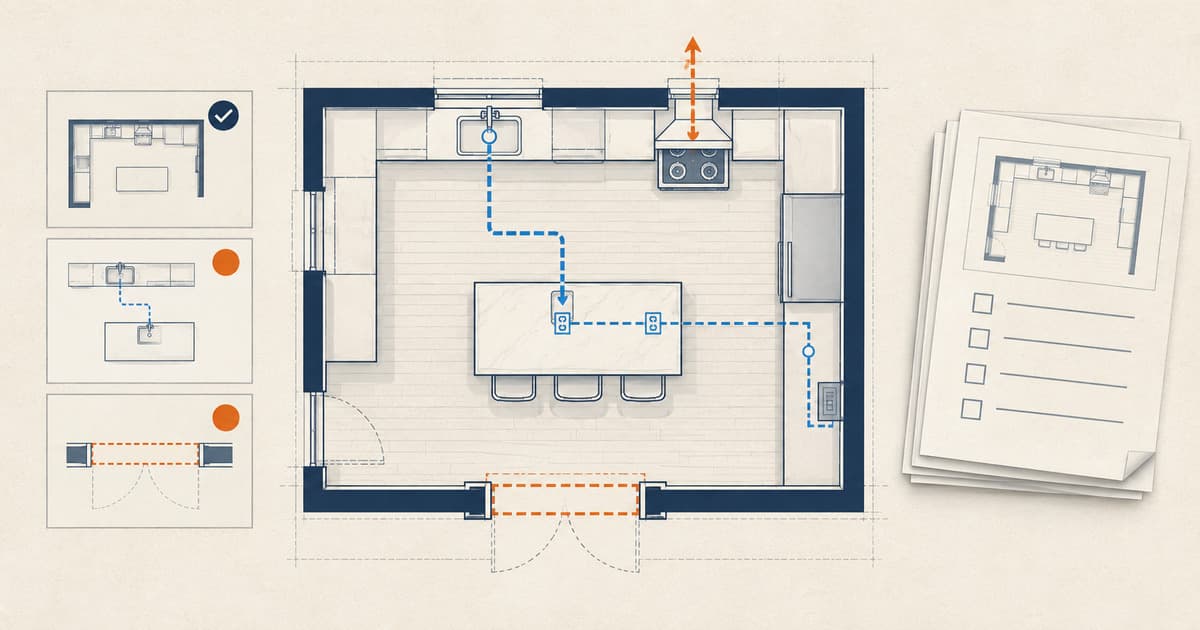
Do You Need a Permit for a Kitchen Remodel?
Learn when cabinets, sinks, islands, appliances, walls, wiring, plumbing, gas, or ventilation can change kitchen-remodel permit and inspection needs.