
Do I Need a Permit for a Fence in Naperville?
Naperville regulates fence height, placement, and materials by yard type, not just district. Here's how the city's zoning ordinance and fence permit process actually work before you build.
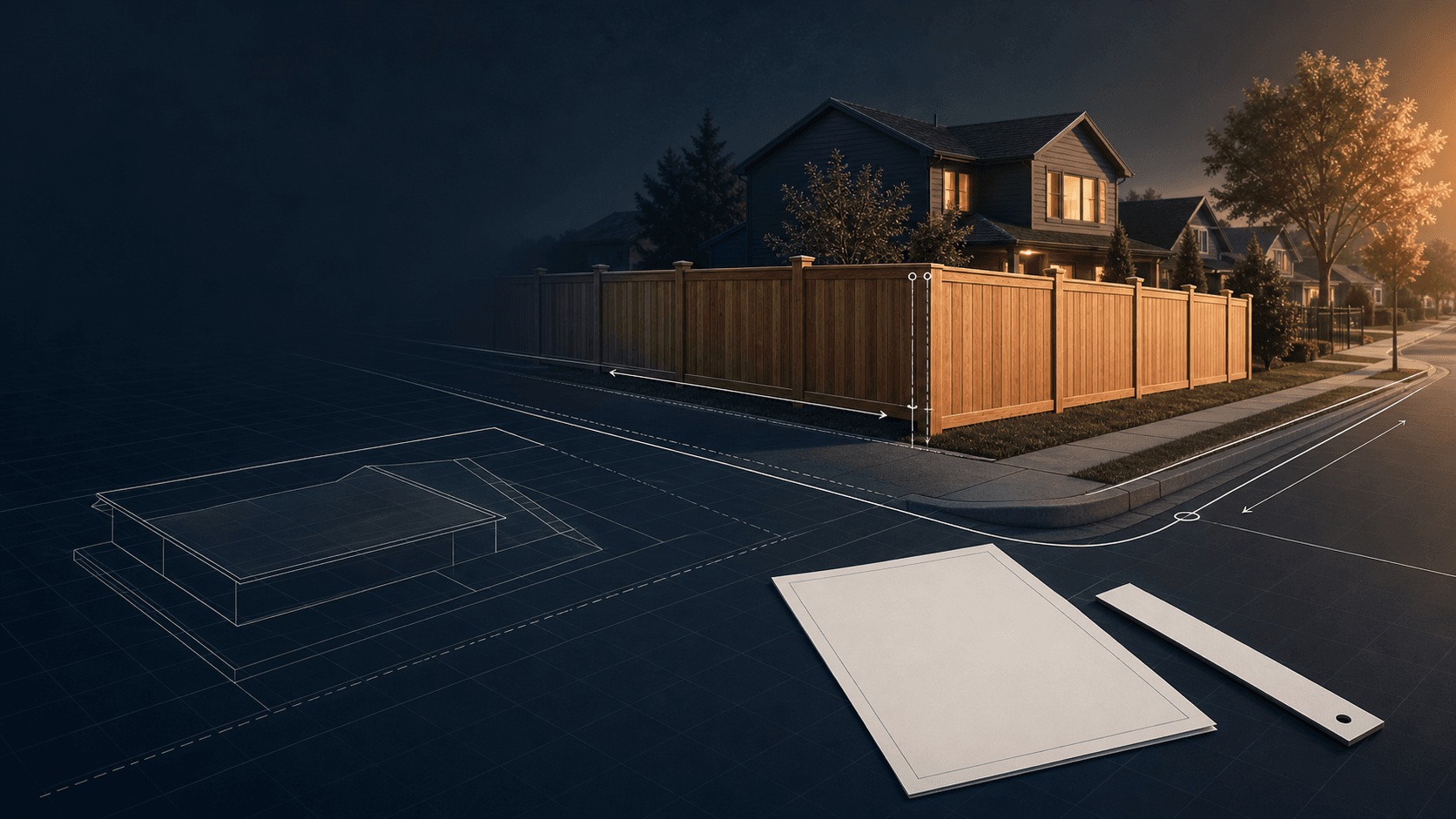
Direct Answer: Most new fences in the City of Naperville require a permit issued through the city's TED (Transportation, Engineering, and Development) Business Group before construction, and the residential fee is a flat $88 with no height condition on it — the City's own residential permit fee schedule prints one unconditional Fence row ($18 clerical fee + $26 permit fee + $44 per inspection, one minimum). Height, placement and materials come from the City's fence permit page and the zoning ordinance behind it; GovCodex's own records cite Municipal Code § 6-2-12 (Fences) and § 6-2-13 (visibility triangle) for that authority, but the enacted text of those sections could not be retrieved, so nothing below is quoted as code. Height and style limits depend on which yard the fence sits in — front, corner side, interior side, or rear — not just your zoning district, and corner lots carry extra placement rules tied to sight lines and the home's front wall. Applications go through the city's Civic Access permitting portal and generally need a marked-up plat of survey.
Verified against official municipal and state sources: July 13, 2026. Requirements change — confirm with the city before applying.
Key Takeaways
- Start with the city's own Fence Permit page, which lists the application steps, required plat of survey, and contact info for TED Business Group.
- The fee is not height-conditioned. The City's residential permit fee schedule carries a single unconditional
Fencerow at $88 ($18 clerical + $26 permit + $44 per inspection, one minimum), and the fence permit page states no height threshold for the fee either. The three-foot figure that does appear in the primary sources is a placement rule, not a fee rule, and it is published on the City's fence permit page rather than in retrievable code: “a fence over three feet (3') high may not extend nearer to a front lot line than the front facade of the principal building” (Fence Permit). - Interior side and rear yards allow fences up to 6 feet; front and corner side yards cap solid fences at 3 feet and open-style fences (with gaps, per the code's definition) at 4 feet.
- Corner lots can't run a fence past the front wall line of the house on either street-facing side, and nothing can obstruct the 30-foot sight triangle at a street intersection.
- The finished (smooth) side of the fence must face away from your own property, toward the neighbor or the street.
- Properties in Naperville's historic district or on individual landmark parcels may need a Certificate of Appropriateness before a fence goes up — check with the Historic Preservation Commission first.
The Practical Rule
Naperville doesn't regulate fences with one blanket height number. The zoning ordinance splits every residential lot into yard types — front yard, corner side yard, interior side yard, and rear yard — and each one carries its own height ceiling and style rule. A privacy fence that's perfectly legal along your rear property line can be an ordinance violation if you run the same design across the front of the lot. The three-foot figure is about placement, not about the fee or the permit trigger, and it is the City's sentence rather than a quotation from the code: “a fence over three feet (3') high may not extend nearer to a front lot line than the front facade of the principal building.” The fee itself is the flat $88 residential row with no height condition. Check with TED Business Group before building anything you're unsure about — especially near a corner, a utility easement, or a historic-district boundary.
What to Check Before You Build
- Pull your plat of survey and confirm the actual property lines. Naperville measures every setback and placement rule from the recorded lot line, not a fence contractor's tape-measure guess or an existing hedge row.
- Identify which yard the fence run falls in. Front, corner side, interior side, and rear yards each have different height caps under Naperville's zoning ordinance, so a single continuous fence around a lot can legally change height and style partway through the run.
- If it's a corner lot, map out the sight triangle. The ordinance prohibits obstructions — including fences — within a 30-foot triangular area at a street intersection, and corner-side-yard fences generally can't extend past the front wall line of the principal building.
- Check for a historic district or landmark designation. If your address falls inside Naperville's historic district or is individually landmarked, contact the city's Historic Preservation Commission liaison before ordering materials — exterior changes there can require a Certificate of Appropriateness on top of the standard fence permit.
- Look for utility equipment on or near the property line. Naperville's ordinance requires clearance around pad-mounted transformers (5 feet on all sides, with a removable gate or panel, or 10 feet in front of the side that opens if there's no gate) and pedestals (3 feet on all sides). Call JULIE at 811 before digging any post holes regardless.
Height, Setback, and Placement Rules by Yard
The table below summarizes how Naperville's zoning ordinance (Title 6, Chapter 2, the fence and general zoning provisions) treats residential fences by location. Always confirm current text against the official code or TED Business Group before finalizing a design, since local amendments do get adopted over time.
| Location on the Lot | Max Height | Style Rule | Notes |
|---|---|---|---|
| Front yard | 3 ft (solid) / 4 ft (open) | Open-style fences must meet the code's "open fence" definition (visible gaps, not a solid privacy panel) | Solid privacy fencing generally isn't allowed in front of the house |
| Corner side yard | 3 ft (solid) / 4 ft (open) | Same open-fence rule as front yards | Can't extend nearer to the side street than the home's front wall line |
| Interior side yard (behind the front building line) | 6 ft | Any permitted material | Finished side must face away from your own lot |
| Rear yard | 6 ft | Any permitted material | Finished side must face away from your own lot |
| Property line abutting a major arterial road / non-residential use | Up to 9 ft | — | Check with TED Business Group for which roads qualify |
| Hobson Road frontage | Height capped under the ordinance | Open designs only (aluminum, wrought iron, PVC, split rail, or three-board) | A corridor-specific rule — confirm current limits directly with the city |
Utility Clearances, Pools, and Historic Districts
If your property borders a Nicor or ComEd transformer pad or utility pedestal, plan the fence line around it before you apply: the ordinance requires a removable gate or panel and a set clearance distance so crews can still service the equipment. Naperville's Building Permits office can confirm exact clearances at (630) 420-6100.
Fences that double as a pool barrier fall under a separate track. Naperville requires a Swimming Pool Permit for any in-ground, above-ground, or on-ground pool, hot tub, or spa capable of holding more than 24 inches of water, and the barrier around it — whether that's the yard fence itself or a dedicated enclosure — has to meet the barrier standards in the swimming pool and spa code the city has adopted, including self-latching, self-closing gates. If your existing yard fence is meant to serve as the pool barrier, confirm with TED Business Group that it actually satisfies those requirements before relying on it.
Historic-district and landmarked properties add one more layer. Naperville's historic district and landmark regulations require a Certificate of Appropriateness for many exterior alterations, reviewed against a COA Requirements Table maintained by the Historic Preservation Commission. The page doesn't spell out fences specifically, so if your lot is in the district, contact the commission's staff liaison before assuming a standard fence permit is the only approval you need.
Illinois has no statewide residential building code — Naperville, like every Illinois home-rule municipality, writes and enforces its own code and zoning ordinance. See Illinois building codes, explained for how that local-control structure works. For the city's broader permitting process beyond fences, see the Naperville building permit guide.
Frequently Asked Questions
Do I need a permit for a short decorative fence under 3 feet in Naperville?
Assume yes. Neither the City's fence permit page nor its residential fee schedule states any height exemption — the fee row is a flat $88 with no condition on it, and the three-foot figure the City publishes is a placement rule about how far forward a fence may come, not an exemption. Confirm with TED Business Group at (630) 420-6100 before skipping the application.
How close to my property line can I build a fence?
Generally a fence can run right up to the property line, with two exceptions: fences over 3 feet can't extend nearer to a front lot line than the front wall of your house, and corner-side-yard fences follow that same restriction on the street-facing side. Confirm your actual line against a plat of survey, not a visual estimate.
My lot is on a corner — which sides count as "front"?
Corner lots effectively have two front-like yards: the true front yard and the corner side yard facing the side street. Both carry the lower height caps (3 feet solid, 4 feet open) and the restriction against extending past the home's front wall line, and the intersection itself is protected by a 30-foot sight-triangle rule.
Does a fence around a pool have different rules?
Yes. A pool, hot tub, or spa holding more than 24 inches of water needs its own Swimming Pool Permit, and the barrier around it — including a yard fence used for that purpose — must meet the barrier standards in the swimming pool and spa code Naperville has adopted, separate from the standard fence rules.
What if my house is in Naperville's historic district?
Check with the city's Historic Preservation Commission before ordering materials. Designated and landmarked properties can require a Certificate of Appropriateness for exterior work, in addition to the standard fence permit.
What documents do I need to apply for a fence permit?
The city's fence permit page lists a copy of your plat of survey with the proposed fence marked on it, submitted through the Civic Access portal. Have your manufacturer's spec sheet or a drawing of the design ready too, since staff check it against the rules for your yard type.
Verify Your Address
Fence rules in Naperville hinge on exactly where a line sits on your lot — front yard, corner side yard, interior side, rear, or a corridor like Hobson Road — so a generic answer isn't a substitute for checking your own property. Review GovCodex's Naperville permit catalog for the current permit types tied to your project, or run a permit check to see what your specific address and fence plan actually require before you buy materials.
Related Articles
Do You Need a Permit to Pour Concrete? Patios, Slabs & Walkways
Pouring concrete may be permit-exempt or regulated depending on whether it is a patio, slab, walkway, driveway, structural base, or right-of-way work.
Do You Need a Permit for an EV Charger?
Learn when a home EV charger needs an electrical permit, when panel or service upgrades enter the project, and how inspection and utility coordination work.
Do You Need a Permit for a Kitchen Remodel?
Learn when cabinets, sinks, islands, appliances, walls, wiring, plumbing, gas, or ventilation can change kitchen-remodel permit and inspection needs.