
Do I Need a Permit for a Fence in Aurora, IL?
Yes — Aurora, IL requires a permit for every fence, no height exemption. Here's how the city's lot-type, yard, and open/solid rules set your height limit, fees, and application steps.
Start with the property and project
An Aurora mailing address alone does not establish City jurisdiction. Permit Check independently resolves the address and governing authority before it applies Aurora sources to the project scope.
Check this property and project against Aurora permit requirementsFor an in-City, source-backed result, GovCodex can prepare unsigned owner-review drafts for supported fence, deck, shed, residential garage, and residential addition scopes. Pool questions may need more facts, and no Aurora pool draft is available.
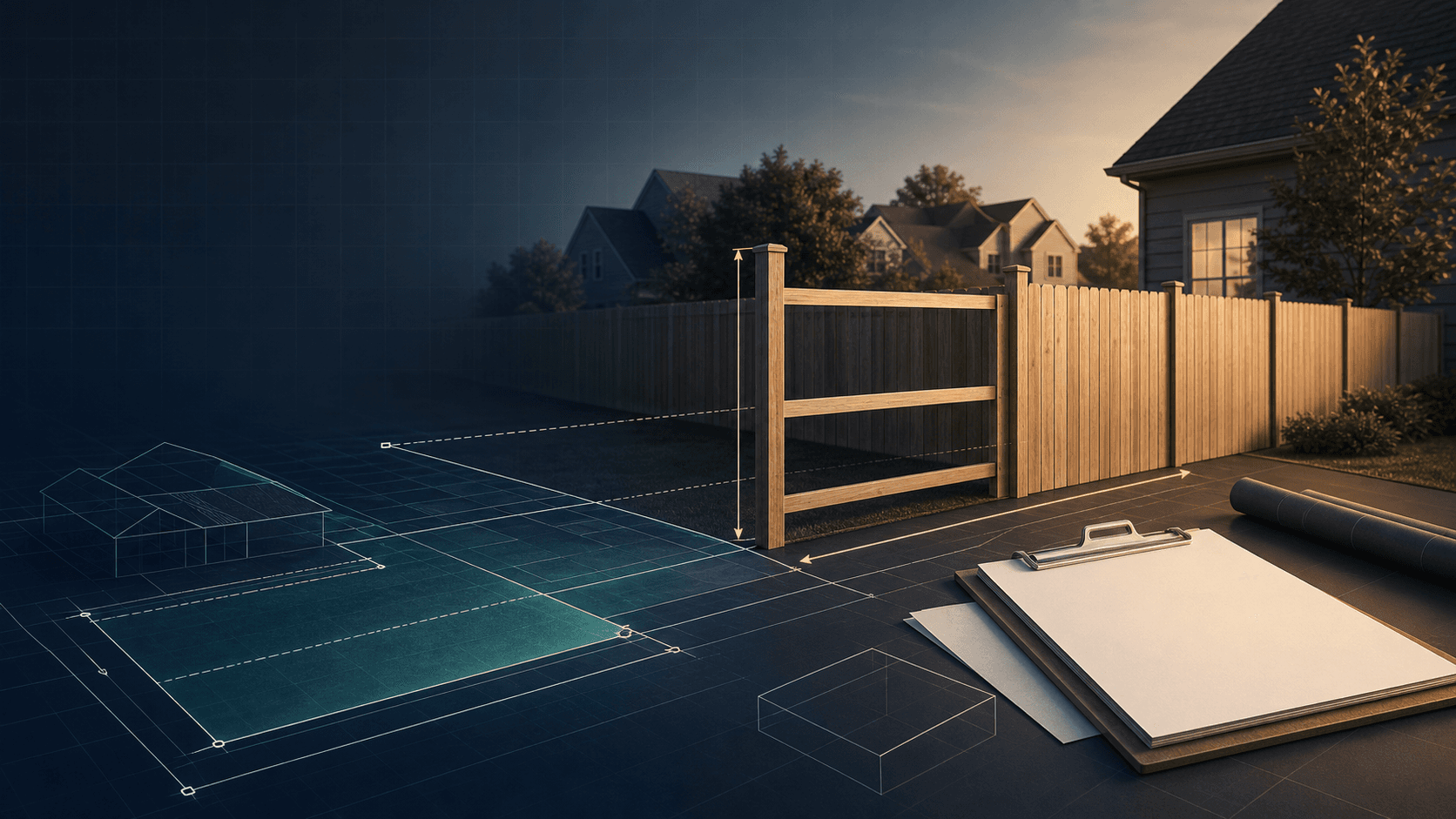
Direct Answer: Yes. The City of Aurora's Development Services Department, Division of Building and Permits, requires a permit before you install, reconstruct, enlarge, or structurally alter any fence — there's no automatic pass for short fences the way some cities allow. What changes is not whether you need a permit, but how tall the fence can be: Aurora sets height limits by lot type (interior, corner, reverse corner, or through lot), by yard (front, interior side, exterior side, or rear), and by whether the fence is classified as "open" or "solid," per the city's Fence permit application and Fence Requirements Booklet. Apply online through the city's eTRAKiT portal or through the Building and Permits Division with a current plat of survey showing the fence's height, material, and placement.
Verified against official municipal and state sources: July 13, 2026. Requirements change — confirm with the city before applying.
Key Takeaways
- Aurora requires a fence permit for installation, reconstruction, enlargement, or structural alteration of any fence, regardless of height or material, per the city's Fence permit application.
- Height limits in residential districts depend on lot type and yard: general baselines are 3 feet for a solid fence and 4 feet for an open fence in front/exterior yards, and 6 feet in most interior side and rear yards, per the Fence Requirements Booklet.
- Within 15 feet of intersecting property lines at public streets, walks, driveways, or bike/walking paths, no fence — open or solid — may exceed 3 feet, to preserve sight lines.
- The city's 2026 Fee Schedule lists a minimum $82 plan-review fee for a residential fence permit, plus an optional $31 inspection fee if you request a final inspection; both scale with the valuation of the work.
- No part of a fence — including posts and footings — may cross the property line, and fences adjacent to a public sidewalk need at least a 1-foot setback from it.
- Chain link is prohibited in front yards and along the right-of-way, and fences generally aren't allowed on vacant lots unless the lot is adjacent to, and under common ownership with, an occupied property.
The Practical Rule
Aurora doesn't use a height threshold to decide whether you need a permit — you always do. The real decision tree is about where the fence sits and how open it is. First, identify your lot type from your plat of survey: interior, corner, reverse corner, or through lot, since each has a different yard layout. Second, work out which yard each section of fence runs through — front, interior side, exterior side, interior rear, or exterior rear — because the height cap can change partway along a single fence run, especially on corner and through lots where part of the "side" or "rear" yard actually faces a street. Third, classify the fence style: Aurora defines an "open" fence as more than 50% open when viewed from outside, and a "solid" fence as less than 50% open; solid fencing is capped lower than open fencing in front and exterior yards. These three variables — lot type, yard, and openness — determine your maximum height, not the other way around. Because fences are accessory structures reviewed under Aurora's Zoning Ordinance rather than a statewide residential code, this is a good moment to note that Illinois has no single statewide residential building code — each home-rule municipality, including Aurora, writes and enforces its own zoning and construction rules.
What to Check Before You Build
- Pull your plat of survey and confirm your lot type. Interior, corner, reverse corner, and through lots each have a different yard map, and Aurora's fence rules are keyed to that map — not to a single citywide height limit.
- Map each yard your fence line will cross. A fence that runs from a rear yard into an exterior side yard on a corner lot can be required to step down in height partway through the run.
- Decide if your design is "open" or "solid." Aurora measures openness as viewed from outside the fence (more or less than 50% open), and that classification — not just the material — sets your height ceiling in front and exterior yards.
- Check the 15-foot sight triangle at corners, driveways, and walkways. Fences there are capped at 3 feet regardless of classification, and a separate 15-foot-by-15-foot obstruction triangle applies where a fence meets a driveway.
- Call J.U.L.I.E. at 800-892-0123 before digging post holes, and check separately whether your subdivision's HOA or, if you're in one of Aurora's historic districts, the city's Historic Preservation Division (630-256-3080) has its own approval process — both are independent of the city's building permit.
How Tall Can My Fence Be? It Depends on Lot Type and Yard
For an interior lot — the most common configuration, with frontage on only one street — the Fence Requirements Booklet sets these baseline height limits:
| Yard | Solid Fence (<50% open) | Open Fence (>50% open) |
|---|---|---|
| Front yard | 3 ft max | 4 ft max |
| Interior side yard (lot ≥ 50 ft wide) | 6 ft max | 6 ft max |
| Interior side yard (lot < 50 ft wide) | 4 ft max | 4 ft max |
| Rear yard | 6 ft max | 6 ft max |
Corner, reverse-corner, and through lots add an "exterior" side or rear yard — the portion of the yard that faces a second street or right-of-way — which is generally capped at 3 feet solid / 4–6 feet open (open-fence limits vary by lot type), with a "height bonus" that lets a solid fence rise to 6 feet if it's set back at least 5 feet from the property line or public sidewalk, whichever is greater. Chain link and wire mesh are prohibited in any front yard and in exterior yards on corner-type lots. Because these rules get lot-specific fast, the booklet includes separate diagrams for each of the four lot types — worth reviewing directly if your property is a corner, reverse-corner, or through lot. For the general mechanics of how yard-based height and setback rules work across jurisdictions, see fence permit rules: height, setbacks, and property lines and what is a setback in zoning.
Non-residential fences (commercial and industrial) follow a simpler standard: 6 feet maximum, increased to 8 feet when the fence is used for screening under the Zoning Ordinance's landscaping and screening provisions, per the same booklet.
Applying for a Fence Permit in Aurora
- Pull a current plat of survey and mark the proposed fence's height, material, style, and exact placement on it.
- Classify your fence as open or solid and identify which lot type and yards it crosses.
- Apply through the city's eTRAKiT online portal or submit the Fence permit application to the Division of Building and Permits at 77 S. Broadway, Aurora, IL 60505.
- Pay the plan-review fee due at submittal; per the 2026 Fee Schedule, residential fences carry a minimum $82 plan-review fee, with the inspection fee (minimum $31) only charged if you request a final inspection.
- Call J.U.L.I.E. (800-892-0123) to have utilities located before digging post holes.
- Build the fence with the finished side facing outward, keeping every post and footing inside your property line.
- If you opted into a final inspection, call 630-256-3130 to schedule it once the fence is complete.
Frequently Asked Questions
Does Aurora exempt short fences from needing a permit?
No. Aurora's permit requirement applies to the installation, reconstruction, enlargement, or structural alteration of any fence, with no minimum-height exemption. Contrast that with cities that only regulate fences above a set height — Aurora regulates all of them, per the Fence permit application.
How tall can my fence be in Aurora?
It depends on your lot type, which yard the fence sits in, and whether it's classified as open or solid. General residential baselines are 3 feet (solid) or 4 feet (open) in front yards, and up to 6 feet in interior side and rear yards on lots 50 feet wide or more, per the Fence Requirements Booklet. Corner, reverse-corner, and through lots have additional exterior-yard limits.
What does a fence permit cost in Aurora?
The 2026 Fee Schedule lists a minimum $82 plan-review fee for a residential fence, plus an optional minimum $31 inspection fee if you request a final inspection; both are calculated from the valuation of the work, so higher-cost installations pay more. Confirm the current figures with the Division of Building and Permits before applying, since fee schedules are adjusted annually.
Can I build my fence right on the property line?
No portion of the fence — including posts and footings — may extend past the property line, and fences next to a public sidewalk need at least a 1-foot setback from it, per the Fence Requirements Booklet. The city does not locate property lines for you or resolve boundary disputes, so if you're unsure exactly where your line runs, get it surveyed before you build.
Do I need my HOA's or a historic district's approval too?
Possibly, and it's separate from the city permit. The booklet notes that HOA approval may be required as its own process, and if your property sits in one of Aurora's historic districts, you'll also need to contact the city's Historic Preservation Division at 630-256-3080 before installing a fence.
Is chain link allowed?
Not in front yards or along the right-of-way, and it's also prohibited in exterior yards on corner-type residential lots and anywhere adjacent to residentially zoned property in a commercial context, per the Fence Requirements Booklet.
Verify Your Address
Because Aurora's fence height limits shift by lot type, yard, and fence classification — not a single citywide number — the safest path is to confirm the rules against your actual plat of survey before you buy materials. Run a permit check or review GovCodex's Aurora permit catalog so the height and setback limits are tied to your specific property, and see the Aurora building permit guide if you're planning other exterior work at the same time.
Related Articles
Do You Need a Permit to Pour Concrete? Patios, Slabs & Walkways
Pouring concrete may be permit-exempt or regulated depending on whether it is a patio, slab, walkway, driveway, structural base, or right-of-way work.
Do You Need a Permit for an EV Charger?
Learn when a home EV charger needs an electrical permit, when panel or service upgrades enter the project, and how inspection and utility coordination work.
Do You Need a Permit for a Kitchen Remodel?
Learn when cabinets, sinks, islands, appliances, walls, wiring, plumbing, gas, or ventilation can change kitchen-remodel permit and inspection needs.